
AO Metal A50 — LPBF metal 3D printer with blue laser option
For the alloys that fight back.
A floor-standing LPBF machine with a Ø50 × 100 mm build, the A50 combines a 300 to 1000 W fiber laser with a blue 445 nm laser option for copper, gold and silver, and a build plate that can run at 900 °C for alloys that crack on a cold plate. Every process setting stays open. Designed and manufactured in the U.S.A.
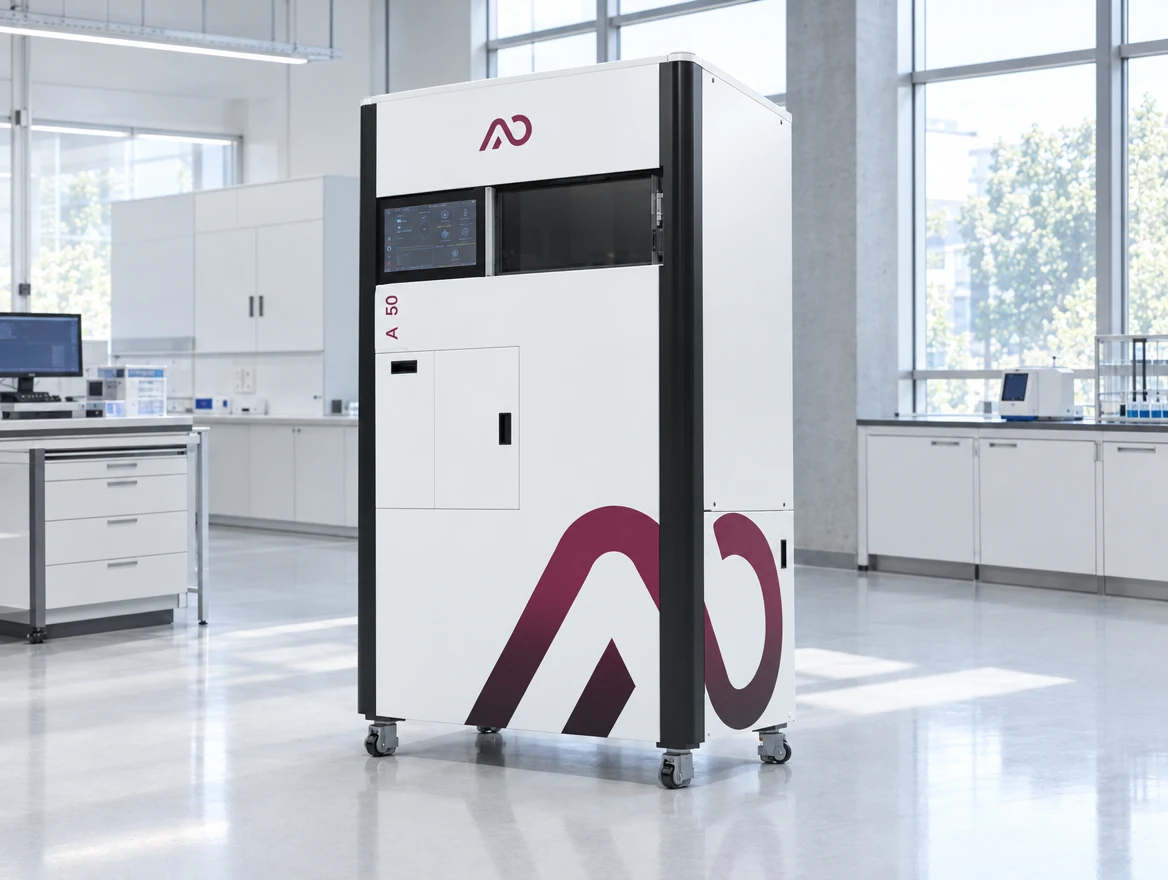
What the A50 is
Built for the material list, not just the part size.
Most metal printers stop at the alloys an infrared laser handles well. Copper, gold and silver reflect most of that light, so they print poorly or not at all; tool steels and some nickel and titanium aluminide grades crack when the plate below them is cold. The A50 answers both: a blue laser that these metals absorb, and a platform heated to 250 °C as standard or 900 °C as an option.
The working cycle is the familiar one. A recoater lays down a thin powder layer, the galvo scanner steers the laser across the slice, and the cylinder drops for the next pass. The machine stands on casters, takes argon at under 2 L/min, and the 300 W model runs from a 110 V single-phase supply.
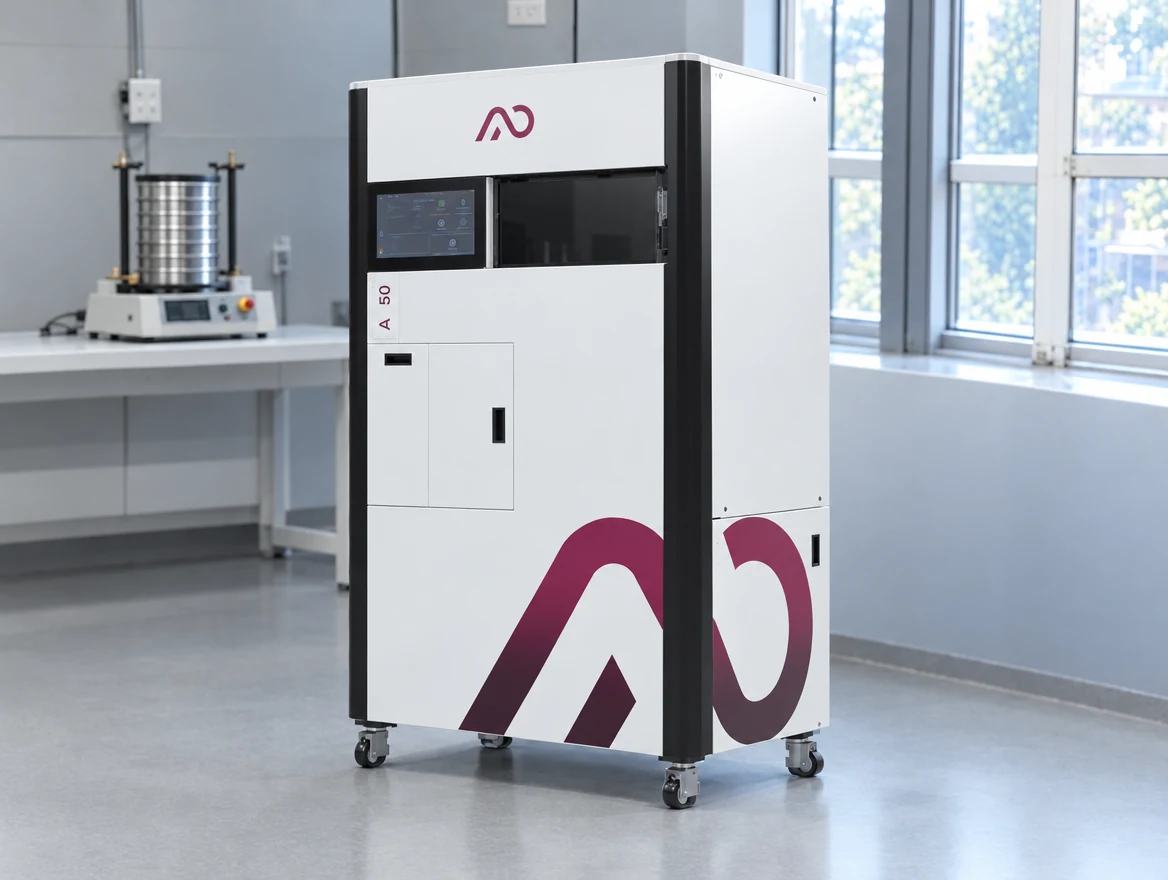
Models and price
| Model | A50-300 | A50-500 | A50-1000 |
|---|---|---|---|
| Fiber laser, 1064 nm | 300 W | 500 W | 1000 W |
| Power supply | 110 V, 1 phase | 220 V, 3 phase | 220 V, 3 phase |
| Power consumption | 4 kW | 6 kW | 8 kW |
| Weight | 350 kg · 772 lb | 400 kg · 882 lb | 450 kg · 992 lb |
| Price | from $89,000 | Quoted on request | Quoted on request |
Every system ships with
- AO Build Studio and AO Build Slicer, with proven parameter sets for the alloys you order
- Build plate, powder dispenser, filters, seals and the tools for a material change
- Installation and operator training, with a named engineer on your account
- 12-month warranty on laser, scanner, blower, motors and electrical systems
Plan for these in your lab
- Required: a wet vacuum cleaner, explosion-proof for reactive metals
- Required: a powder sieving machine
- Recommended: heat-treatment furnace, bandsaw or small lathe, polishing tools
- Argon supply and floor space of about 1150 × 730 mm
The blue laser and the 900 °C platform are options priced in your quotation. Each A50 is built to order, with a lead time of 8 to 14 weeks.
Why labs choose it
Powder for a first build
A test set for under 130 grams of steel.
Powder needed to start a build of test parts 10 mm tall:
For 20 mm parts the figures double: 256 g of 316L, 148 g of Ti-6Al-4V, 90 g of aluminium. A dispenser filled to full height holds 2.69 kg of 316L. A 10 mm cube itself weighs 7.9 g in steel.
Open by design
You set
- Laser power, scan speed and scan strategy
- Layer height and hatch spacing
- Contour and infill exposure, separately per zone
- Plate temperature and which laser runs the job
You will not find
- Chipped powder bottles or cartridges
- A closed list of permitted materials
- An annual software licence
- Anything that blocks a powder you made yourself
Need an alloy we have not run yet? Our process engineers build and validate its parameters and hand over the program.
Technical specifications
| Parameter | A50 |
|---|---|
| Technology | Laser powder bed fusion (LPBF) |
| Build envelope | Ø50 × 100 mm · Ø1.97 × 3.94 in |
| Fiber laser | 1064 nm · 300, 500 or 1000 W |
| Blue laser | 445 nm · 250 W, optional |
| Laser spot | 75 µm · 55 µm optional |
| Scan system | Galvo scan head + F-theta lens |
| Max scanning speed | Up to 12 m/s |
| Layer thickness | 15–100 µm |
| Build plate heating | 250 °C standard · 900 °C optional |
| Inert gas | Argon, under 2 L/min |
| Parameter | A50 |
|---|---|
| Material changeover | 2 hours |
| Software | AO Build Studio + AO Build Slicer |
| File format | STL |
| Power supply | 110 V 1 phase (300 W) · 220 V 3 phase (500, 1000 W) |
| Power consumption | 4 · 6 · 8 kW |
| Dimensions (W × D × H) | 1150 × 730 × 2050 mm · 45.3 × 28.7 × 80.7 in |
| Weight | 350 · 400 · 450 kg |
| Alloys proven to date | 16+, list kept open |
| Warranty | 12 months |
| Price | from $89,000 · 300 W |
Materials
Sixteen alloys proven so far, and the list is open.
Who it is for
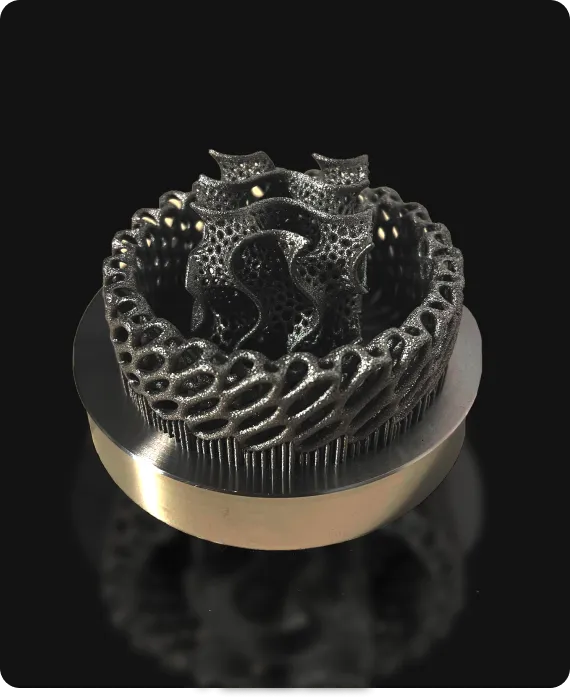
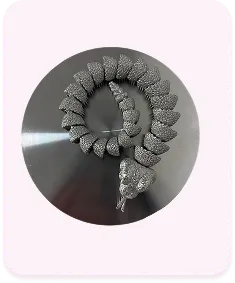
Parts printed on AO Metal
A50 among the line
The A50 sits between the benchtop A30 and the A100. It shares its chassis and options with the A100, which has four times the build area. All three run AO Build Studio, so a process proven on one machine moves to the others as a file.
| Model | A30 | A50 | A100 |
|---|---|---|---|
| Build envelope | Ø30 × 60 mm | Ø50 × 100 mm | Ø100 × 100 mm |
| Format | Benchtop · ≈100 kg | Floor-standing · 350–450 kg | Floor-standing · 350–450 kg |
| Fiber laser | 200 W · 300 W option | 300, 500 or 1000 W | 300, 500 or 1000 W |
| 445 nm blue laser | — | Optional | Optional |
| Build plate heating | Not heated | 250 °C · 900 °C option | 250 °C · 900 °C option |
| Material change | 1 hour | 2 hours | 3 hours |
| Price | $59,000 | from $89,000 | from $99,000 |
From alloy to part
Pair the A50 with an ATO ultrasonic atomizer and a Microtrac particle analyzer, and a new alloy goes from ingot to spherical powder to measured, printed part without leaving your lab. If you would rather not atomize, we can make a custom powder batch for you in three to four weeks. R&D solution, PDF
Questions
Do I need the blue laser?
Only if you plan to print copper, copper alloys, gold, silver or platinum. These reflect most infrared light; the 445 nm blue laser is absorbed far better. For steels, titanium, nickel alloys and aluminium the standard fiber laser is enough.
When does the 900 °C platform matter?
For alloys that crack from thermal stress on a cooler plate, such as some tool steels and titanium aluminides. The standard platform heats to 250 °C, which covers most common alloys.
What is the difference between the A50 and the A100?
The build area. Both use the same chassis, lasers, options and software; the A50 builds Ø50 × 100 mm, the A100 Ø100 × 100 mm, four times the plate area.
What power supply does it need?
The 300 W model runs on 110 V single phase and draws about 4 kW. The 500 W and 1000 W models need 220 V three phase and draw about 6 and 8 kW.
How much space does it take?
The footprint is 1150 × 730 mm and the height 2050 mm. It weighs 350 to 450 kg depending on the model and stands on casters.
What else do we need to run it?
Argon, a wet vacuum cleaner (explosion-proof for reactive metals) and a powder sieving machine. A heat-treatment furnace, a bandsaw or small lathe and polishing tools are recommended for finishing.
Can it run an alloy that is not on your list?
Yes. It is an open system: our engineers develop and validate parameters for a new alloy and give you the program, and you can always tune them yourself.
What do installation and warranty cover?
Installation and operator training are included, with a named engineer for your account. The warranty covers laser, scanner, blower, motors and electrical systems for 12 months.
Downloads
Tell us the alloy and the part.
We will come back with the configuration that fits, a formal quotation and the lead time. Call (747) 800-4854 or write to [email protected].