
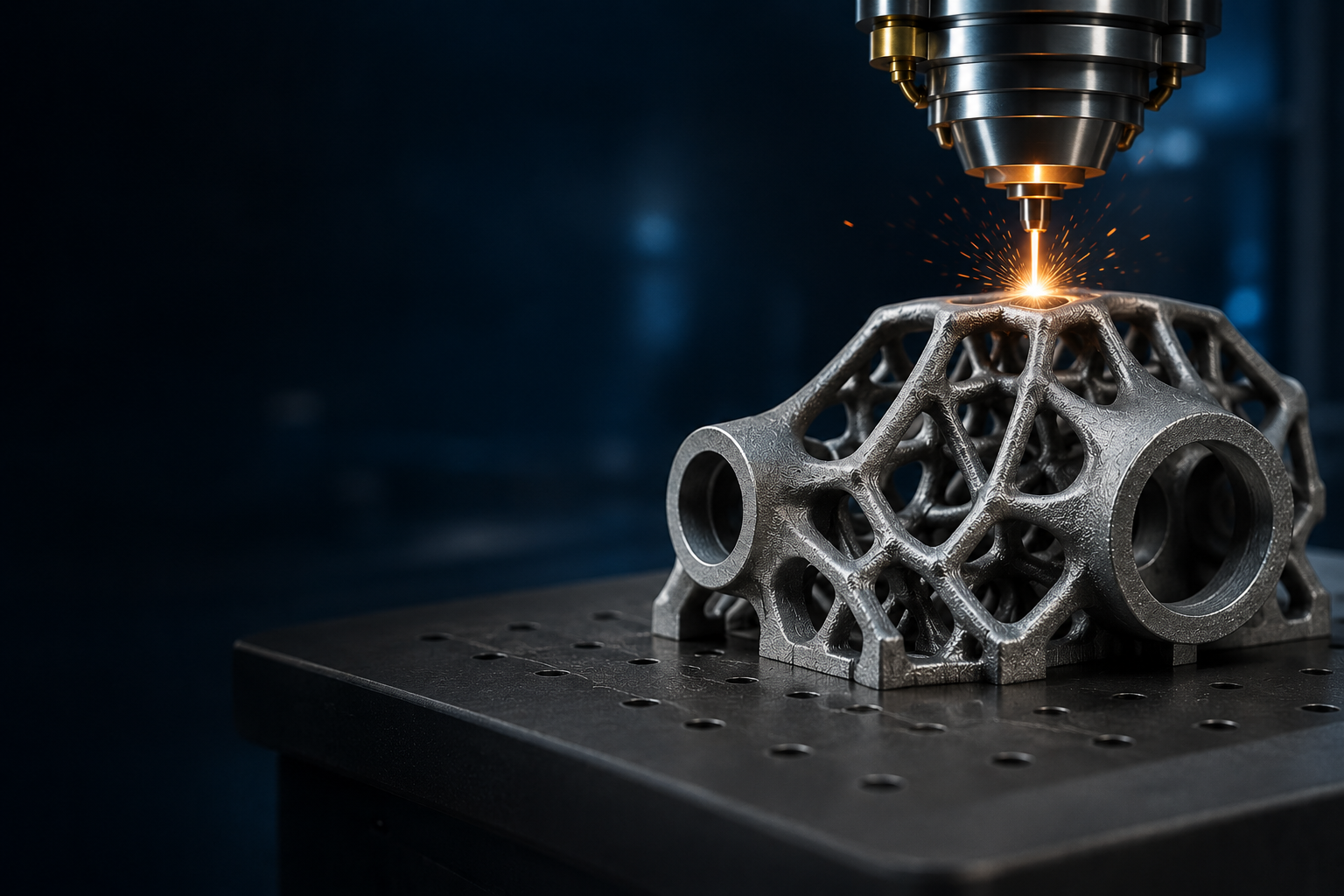
Titanium Ti-6Al-4V is the most widely used titanium alloy in metal additive manufacturing due to its exceptional combination of strength, lightweight properties, corrosion resistance, and biocompatibility. Commonly referred to as Grade 5 titanium, this alloy contains approximately 6% aluminum and 4% vanadium, offering high mechanical performance while remaining significantly lighter than steel.
The alloy has become a preferred material for industrial 3D printing because it enables manufacturers to produce complex, high-performance components with reduced material waste and improved design flexibility. Traditional manufacturing methods often struggle with titanium due to its hardness, machining difficulty, and high tooling wear. Additive manufacturing overcomes many of these limitations by building parts layer by layer directly from digital designs.
Ti-6Al-4V is widely used across industries, including:
- Aerospace for lightweight structural components
- Medical for implants and prosthetics
- Automotive for high-performance lightweight parts
- Defense for durable mission-critical components
- Industrial manufacturing for tooling and custom applications
As metal additive manufacturing continues to evolve, Ti-6Al-4V remains one of the most important materials driving innovation in industrial production.
2. What Makes Ti-6Al-4V Ideal for 3D Printing
Ti-6Al-4V offers a unique balance of mechanical and thermal properties that make it highly suitable for additive manufacturing applications.
Key Advantages of Ti-6Al-4V
- High strength-to-weight ratio
- Excellent corrosion resistance
- Superior fatigue resistance
- Biocompatibility for medical use
- High-temperature performance
- Long service life in demanding environments
Traditional machining of titanium is often expensive and inefficient due to:
- High cutting forces
- Excessive tool wear
- Heat buildup during machining
- Significant material waste
Metal 3D printing solves these challenges by producing near-net-shape parts with minimal waste and greater design freedom. Complex geometries, lattice structures, and internal channels can be manufactured without the limitations of subtractive methods.
Powder Characteristics
The quality of Ti-6Al-4V powder directly impacts print performance. High-quality gas-atomized powder typically features:
- Spherical particle morphology
- Controlled particle size distribution
- Low oxygen contamination
- Consistent flowability
- High packing density
These characteristics ensure stable powder spreading and reliable layer fusion during printing.
3. Overview of Metal 3D Printing Technologies for Titanium
Several additive manufacturing technologies are used for processing Ti-6Al-4V components.
Powder Bed Fusion (PBF)
Powder Bed Fusion is the most common method for titanium additive manufacturing. Thin layers of powder are selectively melted using a laser or electron beam.
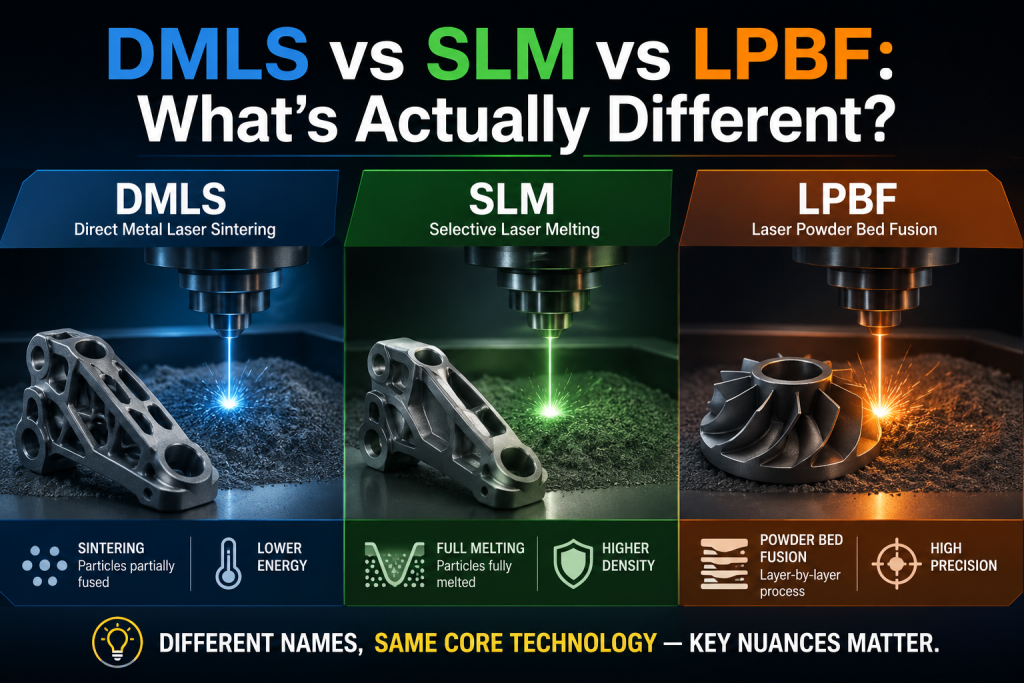
Selective Laser Melting (SLM) / Direct Metal Laser Sintering (DMLS)
SLM and DMLS systems use high-powered lasers to fully melt titanium powder under an inert gas atmosphere. These technologies provide:
- High-dimensional accuracy
- Excellent surface quality
- Strong mechanical performance
- Fine feature resolution
They are widely used for aerospace and medical components.
Electron Beam Melting (EBM)
EBM uses an electron beam in a vacuum chamber to melt powder layers. This process is particularly effective for titanium because it reduces oxidation risk and residual stress.
Advantages include:
- Lower residual stress
- Faster build speeds
- Reduced support requirements
Direct Energy Deposition (DED)
DED systems deposit metal powder or wire directly into a melt pool created by a laser or electron beam. This process is ideal for:
- Repair applications
- Large-scale parts
- Hybrid manufacturing
- Material addition to existing components
Process Comparison
| Technology | Strengths | Best Applications |
| SLM/DMLS | High precision and detail | Aerospace, medical |
| EBM | Lower stress and faster builds | Large titanium components |
| DED | Large-scale repair and deposition | Industrial tooling |
4. Complete Workflow: How Ti-6Al-4V Parts Are Printed
4.1 Design and CAD Preparation
The process begins with creating a 3D CAD model optimized for additive manufacturing.
Design for Additive Manufacturing (DfAM)
Engineers optimize designs to reduce weight, improve performance, and minimize supports. Common DfAM strategies include:
- Topology optimization
- Lattice structures
- Internal cooling channels
- Part consolidation
These capabilities allow manufacturers to produce geometries impossible with traditional machining.
4.2 File Preparation and Slicing
The CAD model is converted into an STL file and imported into slicing software.
The software prepares the build by:
- Defining layer thickness
- Generating support structures
- Setting scan strategies
- Positioning parts for optimal printing
Proper support planning is essential to reduce distortion and maintain dimensional stability.
4.3 Powder Preparation
Ti-6Al-4V powder must be carefully handled to avoid contamination.
Powder Requirements
- Uniform particle distribution
- Controlled oxygen levels
- Dry storage conditions
- Safe handling procedures
Since titanium powder is reactive, inert gas handling and proper safety protocols are essential.
4.4 Printing Process (Layer-by-Layer Fusion)
The printer spreads a thin layer of titanium powder across the build platform. A laser or electron beam selectively melts the powder according to the sliced geometry.
The process repeats layer by layer until the part is complete.
Key Process Parameters
- Layer thickness
- Laser power
- Scan speed
- Hatch spacing
- Build orientation
Printing typically occurs in an argon atmosphere or a vacuum environment to prevent oxidation.
4.5 Cooling and Part Removal
After printing, the build chamber cools under controlled conditions to reduce thermal stress.
The part is then:
- Removed from the build plate
- Separated from supports
- Cleaned of excess powder
Recovered powder is often sieved and reused under controlled quality standards.
5. Post-Processing of Titanium 3D Printed Parts
Post-processing plays a major role in transforming titanium 3D printed parts into fully functional components ready for industrial use. While additive manufacturing enables the production of highly complex geometries and lightweight structures, the printed parts often require additional finishing, stress reduction, and validation before they can meet strict aerospace, medical, automotive, or industrial standards. Proper post-processing improves mechanical performance, dimensional accuracy, surface quality, and long-term durability.
For Titanium Ti-6Al-4V components produced through metal additive manufacturing, post-processing is especially important because titanium parts are commonly used in high-performance applications where strength, reliability, and fatigue resistance are critical. Manufacturers rely on a combination of thermal treatments, machining, finishing techniques, and inspection procedures to ensure consistent quality and repeatable results.
Support Removal
Support structures are necessary during the metal 3D printing process to stabilize overhangs, anchor parts to the build plate, and manage heat transfer during printing. Once the build is complete, these supports must be removed carefully to avoid damaging delicate features or affecting dimensional tolerances.
Support removal methods vary depending on the geometry and complexity of the component. In many cases, operators use bandsaws, wire EDM systems, CNC machining, or manual cutting tools to separate the printed part from the build platform and remove support structures. Complex internal supports may require specialized tooling or machining strategies to access difficult areas.
Efficient support design during the build preparation stage can significantly reduce post-processing time and material waste. Advanced metal 3D printing systems allow engineers to optimize support placement while maintaining part stability during printing. Minimizing support usage not only reduces labor costs but also helps preserve surface quality on critical features.
Heat Treatment and Stress Relieving
Titanium parts produced through laser powder bed fusion experience rapid heating and cooling cycles throughout the printing process. These thermal fluctuations generate residual stresses inside the material, which can potentially lead to distortion, cracking, or reduced mechanical performance if left untreated.
Heat treatment and stress relieving processes are used to stabilize the material structure and improve overall part performance. Controlled thermal cycles help reduce internal stresses while optimizing the microstructure of Titanium Ti-6Al-4V components. Depending on the application requirements, manufacturers may use annealing, stress relief treatments, or advanced thermal processing methods.
Stress relieving is particularly important for large or geometrically complex parts where internal stresses can accumulate during printing. Proper thermal treatment improves dimensional stability and helps ensure consistent performance during machining and final use.
Heat treatment can also enhance ductility, tensile strength, fatigue resistance, and fracture toughness. For aerospace and medical applications, carefully controlled thermal processing is essential for meeting strict certification and quality requirements.
Hot Isostatic Pressing (HIP)
Hot Isostatic Pressing, commonly known as HIP, is one of the most effective post-processing methods for improving the density and structural integrity of titanium 3D printed parts. The HIP process subjects components to extremely high temperatures and isostatic gas pressure inside a sealed chamber. This combination eliminates microscopic internal voids and reduces residual porosity within the material.
HIP processing significantly improves fatigue resistance and mechanical reliability, making it especially valuable for mission-critical applications such as aerospace engine components, orthopedic implants, and high-performance industrial parts. By minimizing internal defects, HIP treatment helps manufacturers achieve material properties closer to or exceeding those of traditionally manufactured titanium components.
In industries where safety and durability are critical, HIP treatment is often considered a standard requirement for production-grade titanium additive manufacturing. The process enhances consistency across production batches and improves long-term component performance under cyclic loading conditions.
Surface Finishing
Surface finishing is another essential stage in titanium post-processing. Parts produced through metal 3D printing often exhibit visible layer lines, partially melted particles, and surface roughness that may not meet final application requirements. Surface finishing techniques improve aesthetics, dimensional precision, and functional performance.
Several finishing methods are commonly used for Titanium Ti-6Al-4V parts:
CNC Machining
CNC machining is frequently used to achieve tight tolerances and create highly accurate mating surfaces. Critical dimensions, threaded features, sealing interfaces, and precision holes are often machined after printing to meet engineering specifications. Combining additive manufacturing with CNC machining enables manufacturers to produce near-net-shape parts efficiently while maintaining excellent accuracy.
Sandblasting
Sandblasting removes loose powder particles and creates a more uniform surface texture. This process improves the visual appearance of the part and prepares surfaces for additional finishing or coating operations. Sandblasting is commonly used as an intermediate finishing step before polishing or machining.
Polishing
Polishing improves surface smoothness and reduces roughness values for applications requiring enhanced aesthetics or reduced friction. In medical and aerospace industries, polished titanium surfaces can improve performance, cleanliness, and corrosion resistance. Internal channels and complex geometries may require specialized polishing techniques to achieve consistent results.
Shot Peening
Shot peening strengthens the surface layer of titanium components by introducing compressive residual stresses. This process improves fatigue resistance and enhances durability under repeated loading conditions. Shot peening is commonly used for aerospace and high-performance engineering applications where long-term mechanical reliability is essential.
Additional finishing methods such as chemical polishing, electropolishing, laser polishing, and coating applications may also be used depending on the final application requirements.
Quality Inspection
Comprehensive inspection and quality assurance procedures are necessary to validate the performance and integrity of titanium 3D printed components. Since additive manufacturing is often used for highly engineered applications, manufacturers must verify that each part meets strict dimensional, mechanical, and metallurgical standards.
CT Scanning
Computed Tomography (CT) scanning enables non-destructive internal inspection of complex titanium components. CT scanning helps detect internal porosity, cracks, inclusions, or hidden defects that cannot be identified through visual inspection alone. This technology is especially valuable for aerospace, medical, and research applications where internal quality is critical.
Dimensional Verification
Dimensional inspection ensures the printed part matches the original CAD model and engineering specifications. Coordinate Measuring Machines (CMM), laser scanners, and optical inspection systems are commonly used to verify tolerances and geometric accuracy. Dimensional verification is essential for components requiring precise assembly or mechanical fitment.
Surface Roughness Analysis
Surface roughness testing evaluates the texture and finish quality of the printed component. Measuring Ra values and other roughness parameters helps determine whether the part meets application-specific requirements. Surface analysis is particularly important for medical implants, fluid flow channels, and high-precision engineering surfaces.
Metallurgical Testing
Metallurgical analysis examines the internal microstructure and material properties of Titanium Ti-6Al-4V parts. Testing may include hardness measurements, tensile testing, fatigue testing, grain structure analysis, and chemical composition verification. These evaluations ensure that the final component meets industry standards and performs reliably under operational conditions.
Advanced inspection and validation procedures help manufacturers maintain process consistency, improve repeatability, and ensure compliance with demanding industrial regulations. As titanium additive manufacturing continues to expand across industries, robust post-processing and quality control
6. Common Challenges in Ti-6Al-4V 3D Printing
Although Titanium Ti-6Al-4V is one of the most widely used materials in metal additive manufacturing, printing high-performance titanium components is far more complex than printing standard polymers or basic engineering metals. Manufacturers must carefully manage thermal behavior, powder quality, machine calibration, atmospheric conditions, and process parameters to achieve reliable and repeatable results.
Titanium additive manufacturing offers exceptional design freedom and material performance, but it also introduces technical challenges that can impact mechanical properties, dimensional accuracy, production efficiency, and overall manufacturing cost. Understanding these challenges is essential for optimizing production workflows and producing aerospace-, medical-, and industrial-grade titanium parts.
Residual Stress and Distortion
One of the most common challenges in Ti-6Al-4V 3D printing is the development of residual stress during the build process. Metal additive manufacturing systems use highly concentrated laser energy to melt titanium powder layer by layer. During printing, the material experiences rapid heating and cooling cycles, which generate significant thermal gradients throughout the component.
As different sections of the part expand and contract unevenly, internal stresses accumulate inside the material. These stresses can lead to distortion, warping, dimensional inaccuracy, or even cracking in severe cases. Thin walls, unsupported features, and large flat surfaces are particularly vulnerable to deformation during printing.
Residual stress becomes even more problematic for large-format titanium components or geometries with complex internal structures. If not properly controlled, thermal stress can cause the part to separate from the build plate or fail before the print is completed.
Manufacturers use several strategies to minimize distortion and residual stress, including:
- Optimized support structures
- Controlled scan strategies
- Heated build platforms
- Stress-relief heat treatment
- Proper part orientation
- Simulation-based thermal analysis
Advanced metal 3D printing systems are increasingly incorporating monitoring and simulation tools that help engineers predict thermal behavior before printing begins. These technologies improve print stability and reduce costly build failures.
Porosity Control
Porosity management is another major challenge in titanium additive manufacturing. Internal defects can significantly reduce mechanical strength, fatigue resistance, and long-term reliability, especially for mission-critical aerospace and medical components.
Porosity typically occurs when process parameters are not fully optimized. Common forms of porosity include:
Lack-of-Fusion Defects
Lack-of-fusion defects occur when the laser energy is insufficient to fully melt and bond adjacent powder layers. This creates weak bonding regions and microscopic gaps within the component. Poor layer fusion can severely compromise structural integrity and reduce load-bearing performance.
Gas Porosity
Gas porosity forms when gas becomes trapped inside the molten material during solidification. Contaminated powder, improper shielding gas flow, or unstable melt pool behavior can contribute to gas entrapment. These microscopic pores can negatively affect fatigue life and mechanical consistency.
Internal Voids
Internal voids may result from inconsistent powder spreading, unstable laser parameters, or thermal irregularities during printing. Even small internal defects can become stress concentration points under cyclic loading conditions.
Controlling porosity requires precise calibration of:
- Laser power
- Scan speed
- Hatch spacing
- Layer thickness
- Powder particle distribution
- Shielding gas flow
Manufacturers often use advanced monitoring systems, CT scanning, and metallurgical analysis to detect internal defects and validate part quality. High-density titanium components are especially important in industries where failure is not acceptable, such as aerospace, defense, and medical implant manufacturing.
Oxidation Sensitivity
Titanium is highly reactive at elevated temperatures, making oxidation control a critical factor during the additive manufacturing process. When exposed to oxygen, nitrogen, or moisture during printing, titanium can absorb contaminants that negatively affect mechanical performance and material integrity.
At high temperatures, titanium reacts rapidly with atmospheric gases, leading to embrittlement and reduced ductility. Even minor contamination can alter the microstructure and compromise the final properties of the printed component.
To prevent oxidation, metal 3D printing systems operate inside tightly controlled inert gas environments, typically using argon or nitrogen shielding. Oxygen levels inside the build chamber must remain extremely low throughout the printing process.
Maintaining atmospheric stability requires:
- High-purity inert gas systems
- Sealed build chambers
- Continuous oxygen monitoring
- Proper powder storage procedures
- Controlled powder handling environments
Powder contamination is also a major concern during recycling and reuse cycles. Repeated exposure to air can gradually increase oxygen content in titanium powder, affecting print consistency and material performance over time.
Strict powder handling protocols are essential for maintaining high-quality titanium production standards.
High Equipment and Material Cost
Titanium additive manufacturing remains one of the more expensive forms of industrial production due to the high cost of equipment, materials, and supporting infrastructure. Industrial laser powder bed fusion systems require advanced optics, thermal management systems, inert gas handling, and precision motion control technologies.
In addition to the cost of the printer itself, manufacturers must also invest in:
- Powder handling systems
- Sieving and recycling equipment
- Safety systems
- Post-processing equipment
- Heat treatment furnaces
- Inspection technologies
- Skilled technical personnel
Titanium powder is also significantly more expensive than many conventional manufacturing materials. Producing high-quality spherical Ti-6Al-4V powder with controlled particle size distribution requires specialized atomization processes and strict quality control.
Despite these costs, many industries continue investing in titanium additive manufacturing because of its long-term advantages, including:
- Reduced material waste
- Lightweight part production
- Design flexibility
- Supply chain simplification
- Faster prototyping
- Consolidation of complex assemblies
As metal additive manufacturing technology becomes more accessible, equipment costs are gradually decreasing, allowing more research institutions, universities, and industrial companies to adopt titanium 3D printing solutions.
Process Optimization Requirements
Successful Ti-6Al-4V printing depends heavily on process optimization and parameter control. Unlike traditional manufacturing methods, additive manufacturing involves a highly dynamic thermal process where small parameter changes can significantly affect final part quality.
Achieving repeatable results requires careful optimization of multiple variables throughout the printing workflow.
Laser Parameters
Laser power, scan speed, hatch spacing, and spot size directly influence melt pool stability and layer bonding. Incorrect laser settings can lead to poor fusion, overheating, excessive spatter, or dimensional inaccuracies.
Powder Quality
Powder consistency is essential for stable printing performance. Particle shape, size distribution, flowability, and oxygen content all impact layer uniformity and material behavior during printing. High-quality powder improves process reliability and reduces defect formation.
Build Orientation
Part orientation affects support requirements, thermal distribution, surface finish, and mechanical properties. Proper orientation can reduce residual stress, minimize post-processing, and improve overall build success rates.
Thermal Management
Thermal control is critical for maintaining dimensional stability and consistent microstructure formation. Engineers must carefully manage heat accumulation, cooling rates, and scan strategies to prevent overheating or distortion during long print cycles.
Advanced simulation software and real-time monitoring systems are increasingly used to optimize titanium additive manufacturing workflows. These technologies help manufacturers reduce trial-and-error experimentation while improving productivity and quality consistency.
As the industry evolves, continued advancements in process monitoring, automation, machine learning, and parameter optimization are expected to further improve the reliability and scalability of Ti-6Al-4V 3D printing for industrial production.
7. Applications of 3D Printed Ti-6Al-4V Parts
Aerospace Components
The aerospace industry uses Ti-6Al-4V for:
- Brackets
- Structural supports
- Engine components
- Lightweight assemblies
The alloy’s lightweight strength helps reduce fuel consumption and improve efficiency.
Medical Implants and Prosthetics
Biocompatibility makes Ti-6Al-4V ideal for:
- Orthopedic implants
- Dental implants
- Customized prosthetics
- Surgical tools
Additive manufacturing enables patient-specific implant production.
Automotive Applications
High-performance automotive manufacturers use titanium parts to reduce weight while maintaining durability.
Defense and Industrial Engineering
Applications include:
- High-strength tooling
- Tactical equipment
- Heat-resistant components
- Complex industrial systems
8. Industrial Equipment for Titanium 3D Printing
8.1 AO Metal 3D Printing Ecosystem Overview
AO Metal provides industrial metal additive manufacturing solutions designed for advanced production workflows. Their systems support titanium printing from research and prototyping to industrial-scale manufacturing.
The ecosystem integrates:
- Metal printing systems
- Powder handling
- Process optimization
- Industrial workflow integration
8.2 AO Metal Product Range
The AO Metal product lineup supports multiple production scales and application requirements for Ti-6Al-4V manufacturing.
8.3 A30 AO Metal 3D Printer
The A30 is a compact metal additive manufacturing system designed for:
- Research and development
- Material testing
- Small-batch titanium production
- Prototype manufacturing
Its smaller build platform makes it ideal for rapid parameter optimization and efficient powder usage.
8.4 A50 AO Metal 3D Printer
The A50 offers a balanced combination of:
- Production capacity
- Precision
- Workflow flexibility
It is suitable for producing functional Ti-6Al-4V components and pilot-scale manufacturing runs.
8.5 A100 AO Metal 3D Printer
The A100 is designed for industrial-scale metal additive manufacturing with:
- Large production capacity
- Advanced process stability
- Aerospace-grade manufacturing capabilities
The system supports high-volume titanium production for demanding industrial applications.
9. Material Considerations for Ti-6Al-4V Printing
Material quality significantly affects printing performance and final part reliability.
Powder Particle Size
Fine powder improves resolution, while larger particles can improve flowability.
Oxygen Contamination Control
Excess oxygen increases brittleness and reduces ductility. Strict handling procedures are necessary throughout the workflow.
Powder Reusability
Recycled powder must be tested to ensure:
- Chemical consistency
- Particle integrity
- Flowability standards
Certification Standards
Industries often require compliance with:
- ASTM standards
- ISO specifications
- Aerospace certification requirements
- Medical material standards
10. Quality Control and Testing Methods
Quality assurance is essential for titanium additive manufacturing.
Mechanical Testing
Tests include:
- Tensile strength testing
- Fatigue testing
- Hardness evaluation
Microstructure Analysis
Metallurgical analysis verifies grain structure and phase distribution.
Non-Destructive Testing
Inspection methods include:
- X-ray analysis
- CT scanning
- Ultrasonic testing
Certification Standards
Many industries require qualification according to strict manufacturing standards for safety-critical components.
11. Cost Factors in Titanium 3D Printing
Several factors influence the total cost of Ti-6Al-4V additive manufacturing.
Machine Investment
Industrial metal printers require significant capital investment.
Powder Cost
Titanium powder production is expensive due to atomization and purity requirements.
Build Time and Energy Consumption
Long print durations and inert atmosphere requirements contribute to operating costs.
Post-Processing Expenses
Additional machining, HIP treatment, and inspection increase production expenses.
However, additive manufacturing can reduce total costs by minimizing waste, reducing assembly requirements, and shortening production cycles.
12. Future Trends in Titanium Additive Manufacturing
The titanium additive manufacturing industry continues to evolve rapidly.
AI-Driven Process Optimization
Artificial intelligence is improving:
- Parameter optimization
- Defect prediction
- Build consistency
Multi-Laser Systems
Advanced systems use multiple lasers to increase production speed and throughput.
Improved Surface Quality
New process strategies aim to reduce post-processing requirements by improving as-printed surface finish.
Sustainable Powder Recycling
Future developments focus on more efficient powder reuse and sustainable manufacturing practices.
13. Conclusion
Ti-6Al-4V has become the leading titanium alloy in additive manufacturing due to its exceptional mechanical performance, corrosion resistance, and lightweight characteristics. Metal 3D printing enables manufacturers to overcome the limitations of traditional machining while producing highly complex, high-performance components.
Successful titanium additive manufacturing depends on optimized workflows, controlled process parameters, proper powder handling, and rigorous quality assurance. As the industry advances, industrial systems such as the AO Metal printer lineup continue to support scalable titanium production across aerospace, medical, automotive, and industrial sectors.
With ongoing improvements in printing technology, automation, and process control, Ti-6Al-4V additive manufacturing is expected to play an even greater role in the future of advanced manufacturing.
More from the blog
Thinking about a metal printer?
See the A30, A50 and A100, or tell us the alloy and the part.