
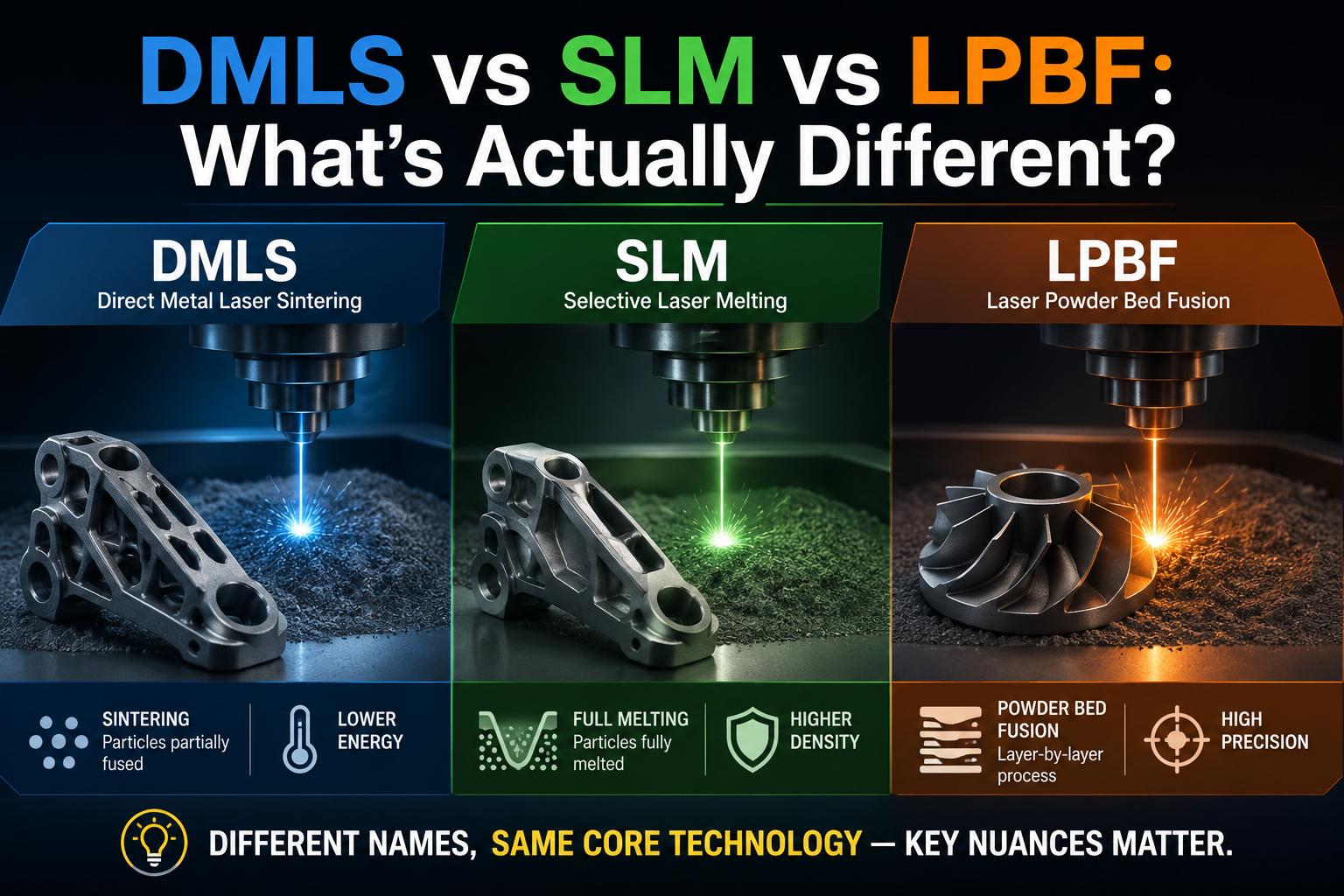
Metal additive manufacturing has transformed how manufacturers design, prototype, and produce complex metal components. However, one topic continues to cause confusion among engineers, researchers, and companies entering the industry: the difference between DMLS, SLM, and LPBF.
You may see these terms used interchangeably across machine specifications, technical articles, and marketing materials. Some manufacturers promote DMLS systems, others advertise SLM technology, while industry standards increasingly refer to LPBF.
So, are these different technologies, or are they simply different names for the same process?
The answer is more nuanced than many realize. While DMLS, SLM, and LPBF all belong to the same family of metal additive manufacturing technologies, understanding the terminology can help buyers make more informed decisions when evaluating metal 3D printers.
In this article, we’ll break down the differences, explain why LPBF has become the preferred industry term, and explore how modern AO Metal systems leverage this technology to produce high-performance metal parts.
What Is Laser Powder Bed Fusion (LPBF)?
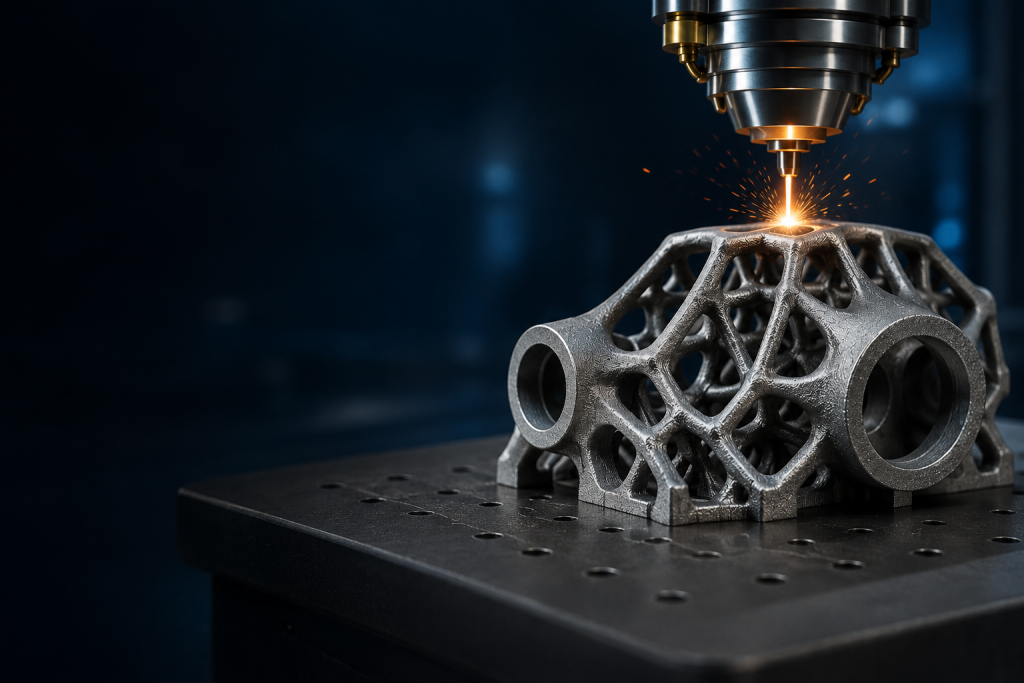
Laser Powder Bed Fusion (LPBF) is an additive manufacturing process that creates metal parts by selectively melting layers of metal powder using a high-powered laser.
The process begins with a thin layer of metal powder spread across a build platform. A laser scans the surface, melting specific regions based on a digital CAD model. Once a layer is completed, the build platform lowers, another layer of powder is applied, and the process repeats until the final component is fully formed.
Because the part is built layer by layer, LPBF enables the production of highly complex geometries that would be difficult, expensive, or impossible to manufacture using traditional methods.
Key advantages of LPBF include:
- High part density
- Excellent dimensional accuracy
- Complex internal channels
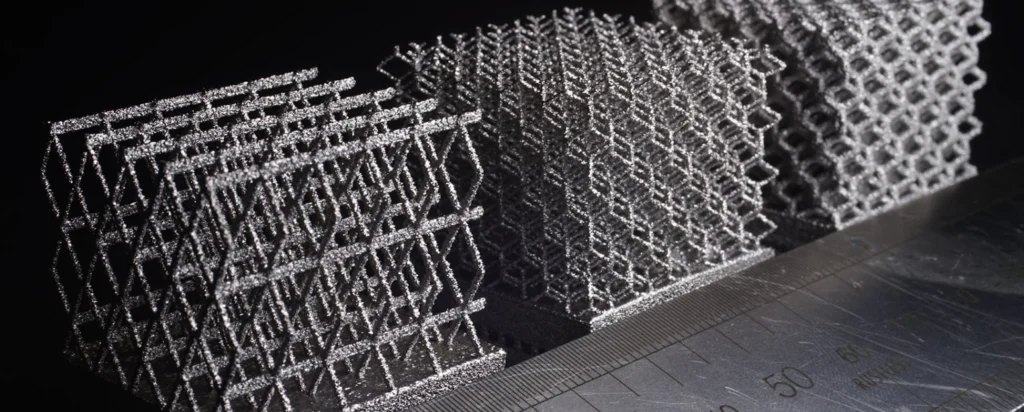
- Lightweight lattice structures
- Reduced material waste
- Tool-free manufacturing
- Rapid design iteration
Today, LPBF is one of the most widely adopted metal additive manufacturing technologies across aerospace, medical, automotive, energy, and research sectors.
What Is DMLS?
DMLS stands for Direct Metal Laser Sintering.
The term was originally introduced to describe a laser-based metal additive manufacturing process where metal powder particles are fused together layer by layer.
Historically, sintering refers to heating a material below its melting point so particles bond together without becoming fully liquid. Because of the name, many people assume DMLS parts are not completely melted.
In reality, modern DMLS systems produce highly dense metal components with mechanical properties comparable to traditionally manufactured parts. The process involves significant melting of the metal powder and produces parts suitable for demanding industrial applications.
Today, DMLS is often viewed as a legacy or manufacturer-specific term rather than a completely separate technology.
What Is SLM?
SLM stands for Selective Laser Melting.
The name emphasizes that metal powder is fully melted during the printing process. Like DMLS, SLM uses a laser to fuse metal powder layer by layer into a solid part.
The workflow is virtually identical:
- Apply a powder layer.
- Scan with a laser.
- Melt designated regions.
- Lower the build plate.
- Repeat until completion.
SLM became popular through manufacturers that used the term to distinguish their systems, but the underlying process remains extremely similar to what many companies describe as DMLS.
For most users, the practical results are the same:
- Dense metal components
- Excellent surface quality
- Strong mechanical performance
- Complex geometric capabilities
Why LPBF Is Becoming the Standard Term
As metal additive manufacturing matured, the industry recognized the need for consistent terminology.
Organizations, researchers, and standards bodies increasingly adopted Laser Powder Bed Fusion (LPBF) because it describes the manufacturing process itself rather than a specific company’s branding.
Instead of focusing on whether the powder is technically sintered or melted, LPBF simply describes the core process:
- A laser energy source
- A powder bed
- Layer-by-layer fusion
This terminology creates a common language across machine manufacturers, material suppliers, researchers, and end users.
Today, LPBF is widely used in:
- Academic research
- Industry standards
- Technical publications
- Material qualification documentation
- Aerospace certification programs
DMLS vs SLM vs LPBF: What’s Actually Different?
At first glance, DMLS, SLM, and LPBF may appear to be different metal 3D printing technologies. In reality, they are very similar processes that use a laser to fuse metal powder layer by layer and create fully dense metal parts.
DMLS (Direct Metal Laser Sintering) and SLM (Selective Laser Melting) are terms that became popular through specific machine manufacturers and vendors. Both technologies use a laser and metal powder feedstock to produce high-quality metal components with excellent mechanical properties and complex geometries.
LPBF (Laser Powder Bed Fusion) is the broader industry term that describes the same family of technologies. Today, LPBF is the preferred terminology used by industry standards organizations, researchers, and many manufacturers because it is vendor-neutral and accurately describes the process.
All three approaches:
- Use a laser as the energy source
- Process fine metal powders
- Build parts layer by layer
- Produce dense, functional metal components
- Support complex geometries that are difficult to manufacture traditionally
The primary difference is not how the machines operate, but rather the terminology used to describe them. While DMLS and SLM are still commonly used in marketing materials and product literature, LPBF has become the most widely accepted technical term across the additive manufacturing industry.
The Key Takeaway
When evaluating a metal 3D printer, focus on factors such as build volume, laser configuration, material compatibility, productivity, and part quality rather than whether the technology is labeled DMLS, SLM, or LPBF. In most cases, the machine’s capabilities will have a much greater impact on your success than the acronym used to describe the process.
The Real Factors That Matter When Choosing a Metal 3D Printer
When evaluating metal additive manufacturing equipment, the acronym on the brochure is far less important than the machine’s actual performance.
Important considerations include:
Laser Technology
Laser power directly impacts build speed, material compatibility, and productivity.
Modern systems may use:
- Single laser configurations
- Dual laser configurations
- Blue laser technology
- Fiber lasers
Blue lasers are particularly valuable for processing highly reflective materials such as copper and certain aluminum alloys.
Build Volume
Build volume determines the maximum size of parts that can be produced.
Organizations printing dental components or jewelry may prioritize compact machines, while aerospace and industrial manufacturers often require larger build areas.
The ideal build volume depends on production goals rather than simply choosing the largest machine available.
Material Compatibility
A printer’s ability to process multiple materials significantly expands its value.
Common LPBF materials include:
Stainless Steel
Widely used for industrial tooling, fixtures, and functional prototypes.
Titanium
Popular in aerospace and medical applications due to its strength-to-weight ratio and corrosion resistance.
Aluminum Alloys
Ideal for lightweight components and thermal management applications.
Cobalt Chrome
Frequently used in medical implants and high-wear industrial parts.
Inconel
Designed for extreme temperatures and demanding aerospace environments.
Copper
Increasingly important for heat exchangers, electronics, and electrical applications.
Industries Using LPBF Technology
LPBF has evolved far beyond prototyping and is now used throughout manufacturing.
Aerospace
Aerospace companies use LPBF to produce lightweight structures that reduce aircraft weight while maintaining strength.
Applications include:
- Brackets
- Fuel nozzles
- Heat exchangers
- Engine components
Medical
The medical industry benefits from LPBF’s ability to create patient-specific devices.
Common applications include:
- Orthopedic implants
- Cranial plates
- Dental frameworks
- Surgical guides
Automotive
Automotive manufacturers use LPBF for:
- Lightweight components
- Performance parts
- Tooling
- Functional prototypes
Research and Education
Universities and research institutions use LPBF systems to:
- Develop new alloys
- Study process parameters
- Explore advanced manufacturing methods
- Train future engineers
AO Metal LPBF Solutions
AO Metal specializes in compact, accessible LPBF systems designed to make industrial metal additive manufacturing available to a broader range of organizations.
AO Metal A30
The A30 is designed for research labs, universities, and material development projects.
Benefits include:
- Compact footprint
- Lower powder consumption
- Cost-effective experimentation
- Efficient material testing
Looking for a Compact Metal LPBF System?
If you’re exploring DMLS, SLM, or LPBF technology and need a machine designed for research, material development, prototyping, or small-batch production, the AO Metal A30 is worth considering.
The A30 AO Metal 3D Printer combines LPBF technology with a compact footprint, making it ideal for universities, research labs, material developers, and manufacturers looking to accelerate innovation while minimizing powder consumption.
Why Consider the AO Metal A30?
- Compact build volume for efficient material testing
- Reduced powder requirements compared to larger systems
- High-precision metal part production
- Suitable for R&D, prototyping, and low-volume manufacturing
- Compatible with a variety of metal materials
Learn more about the AO Metal A30 and its capabilities:
AO Metal A30 3D Printer
Whether you call it DMLS, SLM, or LPBF, choosing the right machine ultimately comes down to your application requirements, material needs, and production goals.
Other AO Metal LPBF 3D Printer Options
If your requirements extend beyond research and prototyping, AO Metal offers larger LPBF systems designed to support higher productivity and manufacturing demands.
AO Metal A50
The AO Metal A50 provides increased capabilities while maintaining affordability and flexibility. It is a strong choice for organizations looking to expand their metal additive manufacturing capacity without moving directly to a production-scale platform.
Key advantages include:
- Enhanced productivity
- Optional blue laser technology
- Greater material versatility
- Industrial-grade performance
Learn more about the AO Metal A50 metal 3D printer for medium-scale production environments.
AO Metal A100
The AO Metal A100 is designed for organizations transitioning toward production-scale metal additive manufacturing. With increased capacity and advanced process controls, it supports more demanding applications and larger production volumes.
Highlights include:
- Larger build capacity
- Advanced process control
- Increased throughput
- Scalable manufacturing workflows
Learn more about the AO Metal A100 metal 3D printer for production-scale additive manufacturing.
Whether you’re evaluating DMLS, SLM, or LPBF technology, selecting the right machine depends on your production volume, material requirements, and long-term manufacturing goals. AO Metal’s A30, A50, and A100 systems provide scalable options for research, prototyping, and industrial production.
Explore the Full AO Metal Portfolio
AO Metal offers a comprehensive range of LPBF metal 3D printers designed for education, research, prototyping, material development, and production applications. Whether you’re looking for a compact system for R&D or a scalable platform for industrial manufacturing, AO Metal provides solutions to support every stage of your additive manufacturing journey.
Explore the full AO Metal portfolio of LPBF metal 3D printers to compare available systems, specifications, and capabilities and find the right solution for your application.
Common Misconceptions About DMLS, SLM, and LPBF
Myth 1: DMLS Is Completely Different From SLM
In practice, the technologies are extremely similar and belong to the same category of metal powder bed fusion processes.
Myth 2: LPBF Is a New Technology
LPBF is not a new process. It is simply the standardized name increasingly used to describe technologies previously marketed as DMLS or SLM.
Myth 3: One Term Automatically Means Better Quality
Part quality depends on machine design, process parameters, materials, software, and operator expertise—not whether the machine is labeled DMLS or SLM.
Myth 4: LPBF Is Only for Aerospace
While aerospace remains a major user, LPBF is now widely adopted across medical, automotive, energy, tooling, jewelry, and education sectors.
The Future of LPBF Technology
Metal additive manufacturing continues to evolve rapidly.
Emerging developments include:
- Multi-laser systems
- Blue laser processing
- AI-driven process optimization
- Faster scanning strategies
- Improved powder recycling
- Advanced alloy development
- Automated post-processing
As these innovations continue, LPBF is expected to become even more accessible and cost-effective for manufacturers of all sizes.
Conclusion
While DMLS, SLM, and LPBF are often presented as different technologies, they all refer to closely related laser-based metal powder bed fusion processes.
Today, LPBF has emerged as the preferred industry term because it accurately describes the technology without relying on manufacturer-specific branding. For engineers and buyers evaluating metal 3D printers, the focus should be on machine capabilities, material compatibility, laser technology, and production requirements rather than the acronym itself.
Modern LPBF systems such as the AO Metal A30, A50, and A100 demonstrate how far metal additive manufacturing has advanced, providing powerful tools for research, prototyping, and production across a wide range of industries.
More from the blog
Thinking about a metal printer?
See the A30, A50 and A100, or tell us the alloy and the part.