
AO Metal R&D bundle — ATO Lab atomizer, Camsizer X2 analyzer, A50 LPBF printer
From your own alloy to a printed part.
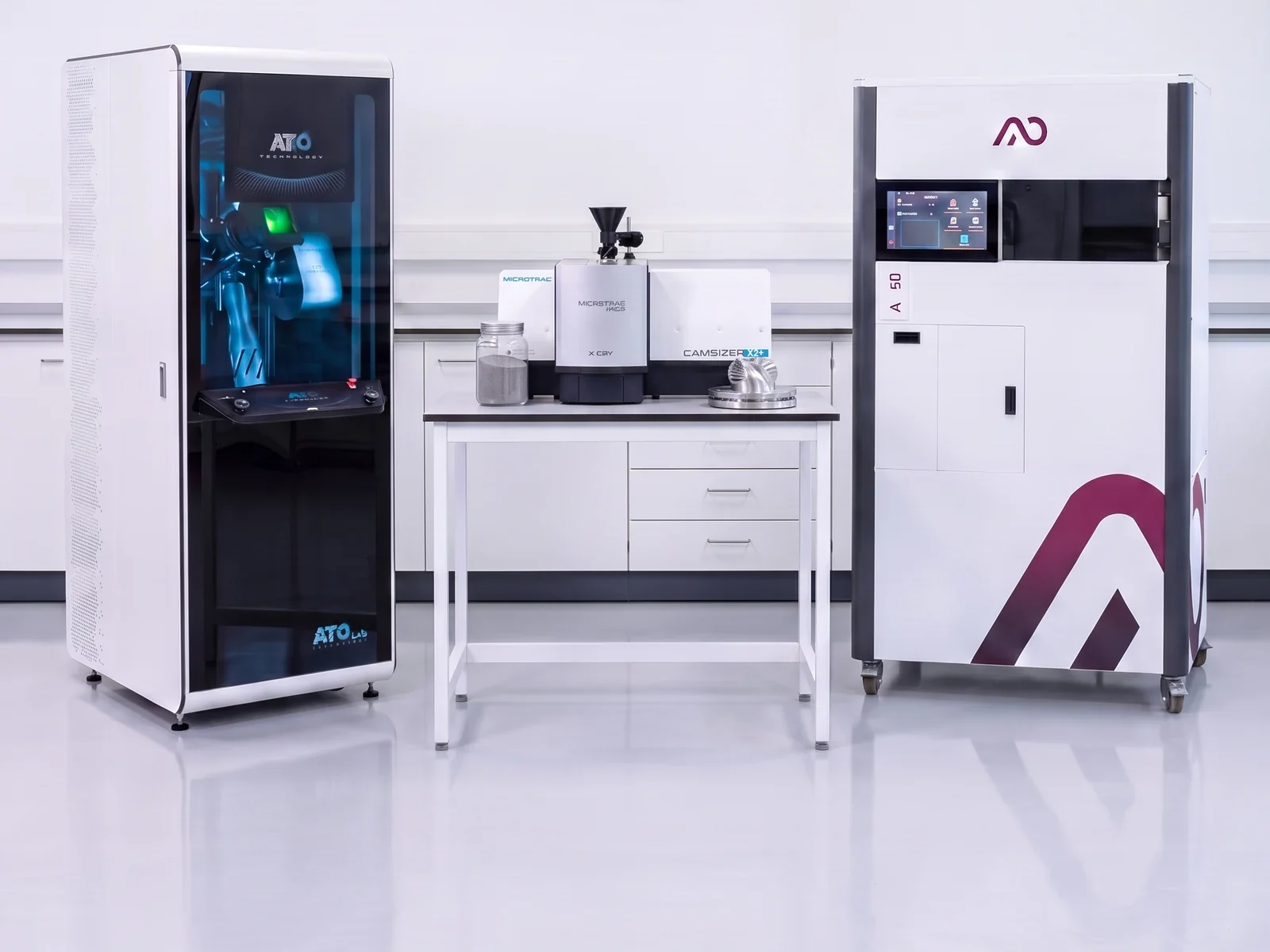
Three systems for one lab: the ATO Lab turns an alloy into spherical powder, the Camsizer X2 measures its size and shape, and the AO Metal A50 prints it. A new composition goes from melt to measured part in days instead of the months it takes to order a custom powder. Supplied, installed and supported by Additive Plus in California.
What it is
Developing an alloy is a loop. This puts the whole loop in your lab.
New metal is made by repetition: melt a composition, check the powder, print, section the part, change one thing and run it again. When the powder has to be ordered from outside, every turn of that loop waits on a minimum order and a lead time. With an atomizer, an analyzer and an open printer side by side, a turn takes an afternoon and only as much material as the experiment needs.
Each step stays visible. You see the particle size, shape and sphericity before you print, so a poor build can be traced to the powder or to the parameters rather than guessed at. All three systems keep their settings open, so the whole process is yours to change.
The three systems
The three are engineered to work together and are available as a bundle or individually. If you already own one part of the loop, we quote only what is missing.
What changes
With the loop in-house
- A custom powder is an afternoon and the amount you need, not a minimum order and a lead time
- Powder quality is measured before every build
- Failed builds are traced to powder or parameters, not guessed at
- Settings stay open on all three systems
Who runs one
- Universities and technical training centres
- National-lab and corporate R&D groups
- Engineering programmes and materials teams developing their own alloys
- Anyone working with scarce, refractory or precious metals, where waste is the cost
Technical specifications
| ATO Lab | |
|---|---|
| Melting | Ultrasonic + plasma, TIG or induction |
| Particle size | 20–120 µm |
| Sphericity | Above 0.95 |
| Max alloy temperature | Above 3000 °C |
| Input material | Any shape and amount, waste close to zero |
| Atmosphere | Fully air-tight |
| Parameters | Open |
| Dimensions (W × D × H) | 1994 × 813 × 1138 mm |
| Origin | Made in Poland, patented in the U.S.A. |
| Camsizer X2 | |
|---|---|
| Principle | Dynamic image analysis, ISO 13322-2 |
| Measuring range | 0.8 µm – 8 mm |
| Detection area | About 20 × 20 mm |
| Dimensions (W × D × H) | 850 × 580 × 570 mm |
| Origin | Made in Germany |
| AO Metal A50 | |
|---|---|
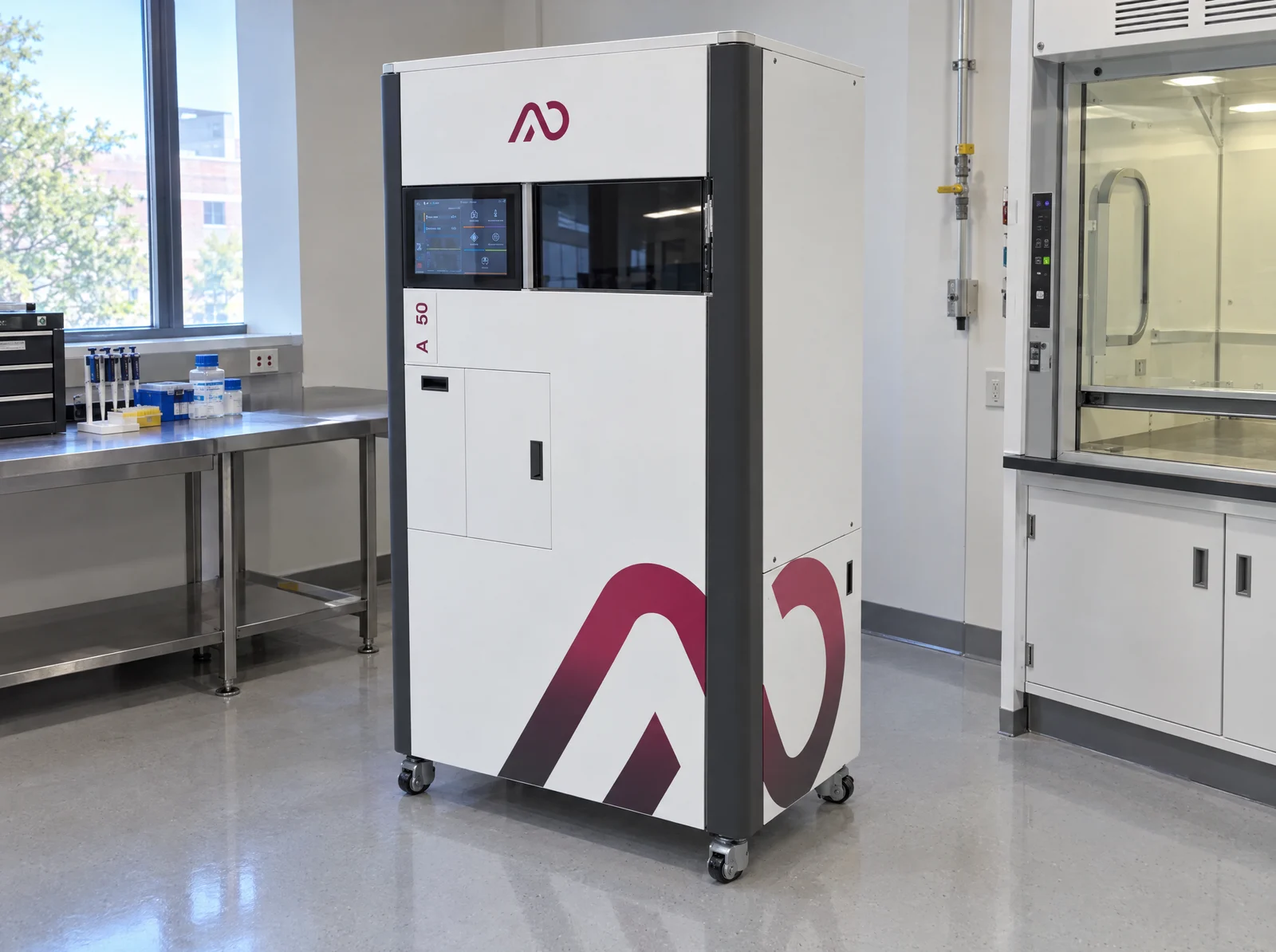
| Build volume | Ø50 × 100 mm |
| Fiber laser | 300 W, 1064 nm · 500 or 1000 W optional |
| Blue laser | 445 nm, 250 W, optional |
| Build plate | 250 °C · 900 °C optional |
| Layer · spot | 15–100 µm · 75 µm (55 µm optional) |
| Dimensions (W × D × H) | 1150 × 730 × 2050 mm |
| Price | from $89,000 |
Materials
The loop is built for these alloys, and for the ones you invent.
Prefer not to atomize yourself? We can produce a custom powder batch to your composition, typically in three to four weeks.
Questions
Can we buy only part of the bundle?
Yes. The ATO Lab, the Camsizer X2 and the A50 are available individually. If you already have a printer or an analyzer, we quote the systems you are missing.
How much powder does the atomizer need?
The ATO Lab accepts input material of any shape and amount and produces close to zero waste, which matters most for scarce, refractory and precious metals.
Why measure powder before printing?
Particle size distribution and shape decide how the powder spreads and melts. Measuring each batch on the Camsizer X2 lets you separate powder problems from parameter problems when a build goes wrong.
Can the A50 run the alloys we develop?
Yes. It is an open system: every laser and scan parameter is yours to set, and there is no list of approved materials. Our process engineers can help develop parameters for a new composition.
What is included?
All three systems, installation and training on site, and support from our team in California. The quotation lists the exact configuration, price and lead time.
What does the bundle cost?
It depends on the configuration: melting method on the ATO Lab, laser power and options on the A50. Send us the alloys you plan to develop and we will return a formal quotation.
Downloads
Tell us the alloy you want to develop.
We will say which parts of the loop you already have and quote the rest, with configuration, price and lead time. Call (747) 800-4854 or write to [email protected].