
AO Metal A100-HT — LPBF metal 3D printer with a 900 °C build plate
For alloys that crack on a cooler plate.
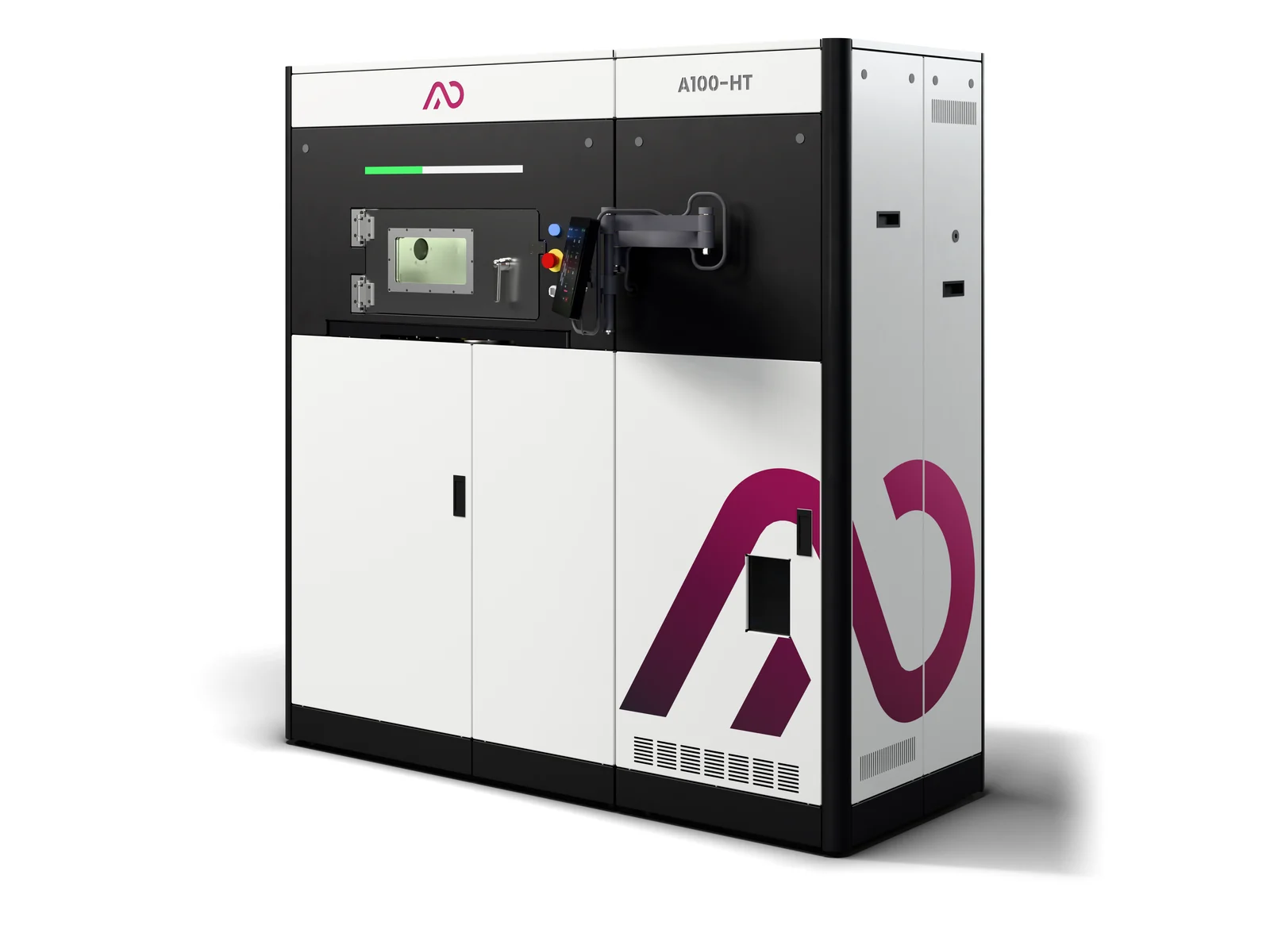
The A100-HT builds on a Ø100 × 100 mm plate, four times the area of the A50-HT, heated by induction to 900 °C. For nested builds and short series in crack-prone alloys such as tool steels and refractory metals. A 300, 500 or 1000 W fiber laser, a water chiller and every process setting open. Designed and manufactured in the U.S.A.
What the A100-HT is
A printer of its own, built around the heat.
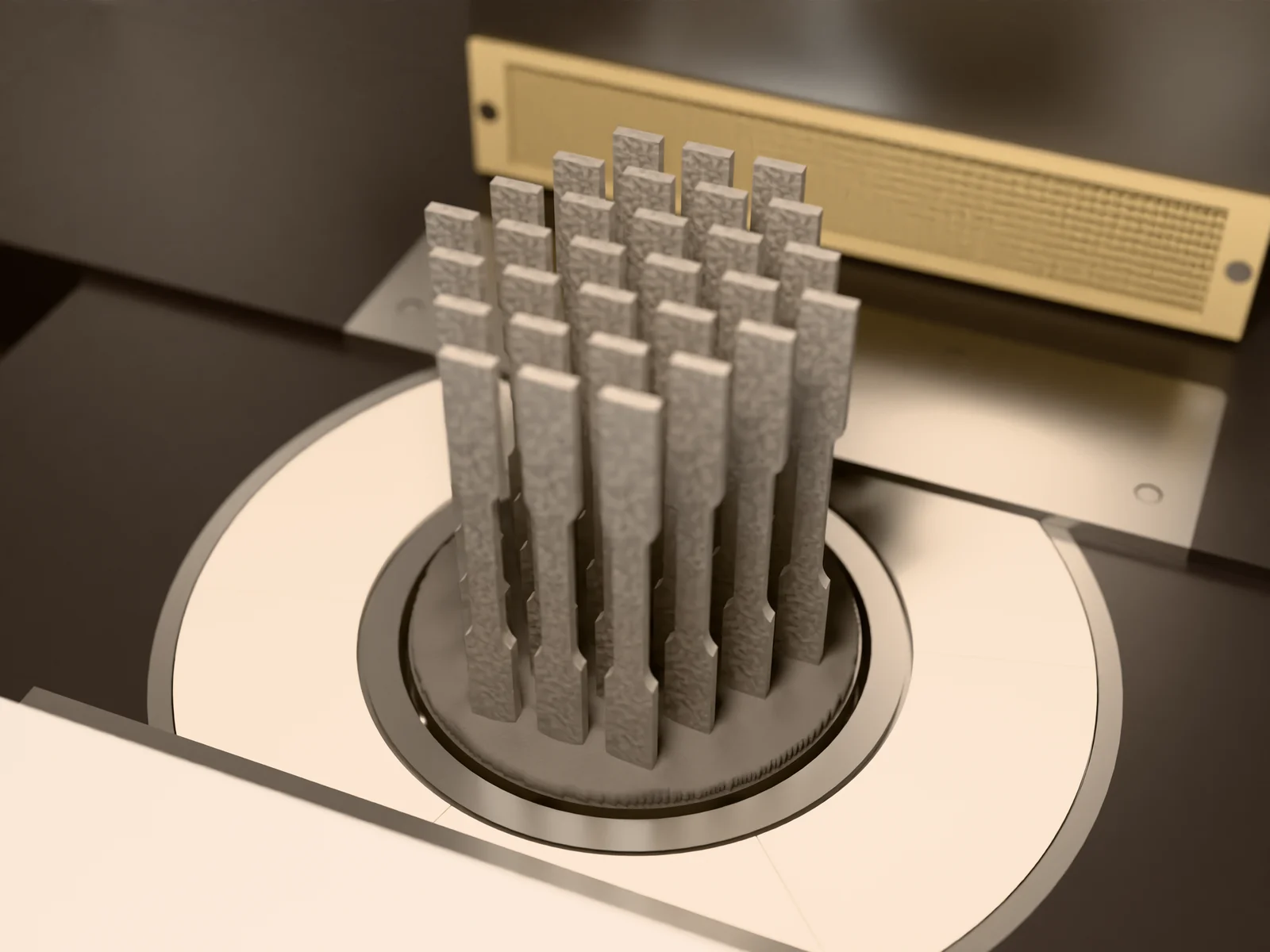
Some alloys only print well hot. Tool steels such as H13 and refractory metals such as tungsten, tantalum, niobium and molybdenum build up thermal stress as each layer cools, and crack when the plate below them is cooler. The A100-HT is built around an induction-heated build module: the plate under the part reaches 900 °C, and the temperature is set per job in AO Build Studio.
It keeps the A100’s Ø100 × 100 mm build, four times the A50-HT plate area, with the same fiber lasers and software, so a process proven on the A50-HT moves up as a file. A water chiller comes with the printer and stands beside it, and the machine runs on 208 V three phase.
How it differs from the A100
Comes with
- A 900 °C induction-heated build plate, as standard
- A water chiller beside the printer
- A 208 V three-phase input, 60 Hz, for a 60 A circuit
- The same fiber lasers: 300, 500 or 1000 W
The A100-HT is priced in a formal quotation, with configuration, payment terms and lead time. Each one is built to order, with a lead time of 8 to 14 weeks.
Why labs choose it
Technical specifications
| Parameter | A100-HT |
|---|---|
| Technology | Laser powder bed fusion (LPBF) |
| Build envelope | Ø100 × 100 mm · Ø3.94 × 3.94 in |
| Fiber laser | 1064 nm · 300, 500 or 1000 W |
| Blue laser | Not offered on the HT printers |
| Laser spot | 75 µm · 55 µm optional |
| Scan system | Galvo scan head + F-theta lens |
| Max scanning speed | Up to 12 m/s |
| Layer thickness | 15–100 µm |
| Build plate heating | Induction heated, up to 900 °C |
| Inert gas | Argon, under 2 L/min |
| Parameter | A100-HT |
|---|---|
| Cooling | Water chiller, included · 750 × 560 × 1020 mm, 85 kg |
| Material changeover | About 3 hours |
| Software | AO Build Studio + AO Build Slicer |
| File format | STL |
| Power supply | 208 V 3-phase · 60 Hz · 60 A circuit · IEC 60309 60 A receptacle or hardwired |
| Peak power, estimated | About 12.8 kW with the chiller, most of it the induction generator at full output; about 1 kW for the heated plate while printing |
| Dimensions (W × D × H) | 1890 × 810 × 1950 mm · 74.4 × 31.9 × 76.8 in, chiller separate |
| Floor space with the monitor arm | 1890 × 1160 mm · 74.4 × 45.7 in |
| Weight | 750 kg · 1,655 lb, plus the 85 kg chiller |
| Warranty | 12 months |
| Price | Quoted |
Materials
Made for the alloys that need heat.
The A100-HT runs the A100 alloy list except the metals that need the blue laser. The list is open: for an alloy we have not run yet, our process engineers develop and validate the parameters and hand over the program.
Who it is for
A100-HT among the line
The A100-HT shares its build size and software with the A100, and its heated build module with the A50-HT. All of them run AO Build Studio, so a process proven on the A50-HT moves up as a file.
| Model | A100 | A50-HT | A100-HT |
|---|---|---|---|
| Build envelope | Ø100 × 100 mm | Ø50 × 100 mm | Ø100 × 100 mm |
| Build plate heating | 250 °C | 900 °C, induction heated | 900 °C, induction heated |
| Fiber laser | 300, 500 or 1000 W | 300, 500 or 1000 W | 300, 500 or 1000 W |
| 455 nm blue laser | Optional | — | — |
| Material change | 3 hours | About 2 hours | About 3 hours |
| Price | from $99,000 | Quoted | Quoted |
Questions
When do we need the A100-HT rather than the A100?
When the alloy cracks from thermal stress on the A100’s 250 °C plate: some tool steels such as H13, and refractory metals such as tungsten, tantalum, niobium and molybdenum. For steels, titanium, nickel alloys and aluminium the A100 is enough.
Why is there no blue laser?
The HT printers are built around the induction-heated build module and run the fiber laser. Copper, gold and silver need the 455 nm blue laser, which is offered on the A50 and A100.
What power supply does it need?
208 V three phase, 60 Hz: three lines and ground, no neutral, from a 60 A circuit through an IEC 60309 60 A pin-and-sleeve receptacle, or hardwired. By our estimate the printer peaks at about 12.8 kW with its chiller, which runs from the printer, most of it the induction generator at full output; by our calculation the heated build module takes about 1 kW while printing.
How much space does it take?
The printer is 1890 × 810 mm and 1950 mm tall. With the monitor arm out it takes 1890 × 1160 mm of floor, and the arm comes off to pass a 32-inch door. It weighs 750 kg. The water chiller stands beside it: 750 × 560 mm, 1020 mm tall, 85 kg.
What else do we need to run it?
Argon, a wet vacuum cleaner (explosion-proof for reactive metals) and a powder sieving machine. A heat-treatment furnace, a bandsaw or small lathe and polishing tools are recommended for finishing.
How is it priced?
In a formal quotation with the configuration, price, payment terms and lead time. Tell us the alloy and the part, or put the configuration together in the configurator.
What do installation and warranty cover?
Installation and operator training are included, with a named engineer for your account. The warranty covers laser, scanner, blower, motors and electrical systems for 12 months.
Downloads
Tell us the alloy and the part.
We will come back with the configuration that fits, a formal quotation and the lead time. Call (747) 800-4854 or write to [email protected].