
Blog · Labs & universities · April 5, 2025
How to Choose a 3D Printer for Research Laboratories: From Basic Features to Advanced Technologies
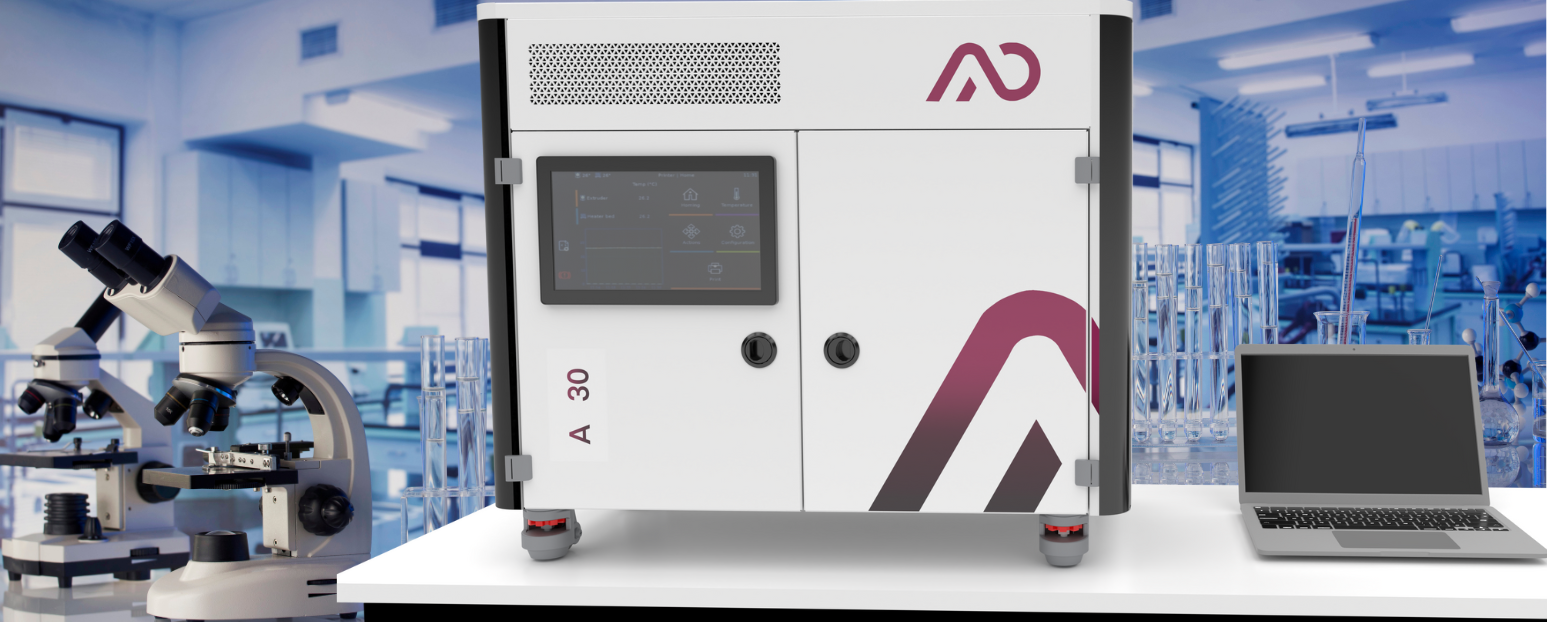
Research laboratories are at the forefront of innovation, solving complex challenges that demand precision and efficiency. 3D printing has become a crucial tool, empowering labs to create intricate prototypes, develop advanced materials, and test concepts quickly and in-house. Over 68% of companies using 3D printing rely on it for prototyping and small-scale production.
From producing patient-specific implants in healthcare to exploring new alloys in material sciences, 3D printing streamlines workflows and drives innovation.
With so many options available, choosing the right 3D printer can be daunting. This guide will help you identify essential features and explore models like the A30 and A50, tailored for research excellence.
Key Selection Criteria: Compactness, Rare Materials, and Open-Source Software
66% of research and education organizations use their own 3D printers. When selecting a 3D printer for research laboratories, three criteria should guide your decision: compact size, compatibility with rare and specialized materials, and the flexibility of open-source software.
Here’s why each matters and how to evaluate them.
Compactness: Making the Most of Limited Space
Laboratory space is often limited, and bulky equipment can create logistical challenges. A compact 3D printer like the A30 is designed to fit seamlessly into tight spaces, passing through standard doors and even fitting in conventional elevators. This eliminates the need for costly renovations or complex installation processes.
- Compact printers are easier to move and reposition, ideal for dynamic lab setups.
- Look for models that balance small size with advanced functionality, ensuring no loss in performance.
- Compact designs also simplify installation in shared lab spaces or multi-use environments.
Working with Standard, Rare, and Specialized Materials
Research often requires working with diverse materials that are or aren’t commonly used in traditional manufacturing, such as biocompatible titanium for medical implants, refractory alloys for aerospace, or biodegradable magnesium for biomaterials.
- Ensure the printer supports a wide range of materials, including titanium, cobalt-chrome, Inconel, and magnesium.
- Fast material changeover (e.g., under an hour) is critical for efficient experiment transitions.
- Versatile material compatibility allows labs to address multidisciplinary research needs.
The blue laser technology allows you to work with a wider range of materials, opening up possibilities to experiment with diverse structures.
Open-Source Software: Unlocking Innovation
In research, flexibility is key. Open-source 3D printing software allows users to modify and customize settings for unique applications.
- Fine-tune parameters like laser power, scanning speed, and layer thickness to match specific experiments.
- Open platforms enable collaboration by allowing researchers to share profiles and integrate analytics.
- Avoid limitations of closed systems by choosing printers with adaptable software for long-term versatility.
By prioritizing compactness, material compatibility, and open-source software, research laboratories can invest in 3D printing systems that meet their current needs and adapt to future challenges. These features ensure a printer that integrates seamlessly into the lab, supports diverse projects and fosters innovation without limitations.
How Unique Print Volumes Cater to Research Needs
The choice of print volume directly impacts a 3D printer’s suitability for various research tasks. Printers with unique build envelopes, such as Ø30×60 mm, Ø50×100 mm, and Ø100×100 mm, provide tailored solutions for diverse laboratory applications. Each size is designed to address specific experimental requirements and maximize efficiency in material usage.
- Ø30×60 mm: Perfect for creating small, intricate components like gyroids, short tensile specimens, and prototypes for material testing. Its compact build minimizes waste, making it ideal for labs focused on high-precision work or working with expensive rare materials.
- Ø50×100 mm: A versatile option that balances compactness with the ability to produce medium-sized parts. This volume is well-suited for projects requiring components like structural prototypes, medical implants, or aerospace parts where precision and moderate size are essential.
- Ø100×100 mm: Ideal for larger experimental setups or when working with complex assemblies and structures. It accommodates extensive prints for applications like automotive research, advanced tooling, and components requiring multiple materials.
Tailored to Experiments and Materials
The availability of multiple build volumes ensures researchers can choose the size that best aligns with their project goals and materials:
- Smaller print volumes are more economical for material usage, be it titanium and Inconel or more expensive ones
- Larger volumes enable experiments requiring multiple iterations or larger-scale prototypes, supporting faster research workflows.
- Flexible build size options eliminate the need for multiple printers, offering a one-stop solution for multidisciplinary research environments.
By providing varied print volumes, 3D printers enable research labs to optimize space, materials, and productivity, ensuring that every project—big or small—can be handled with precision and efficiency.
What Makes Us Unique: Revolutionizing LPBF with Blue Laser Technology
At AO, we pride ourselves on breaking boundaries in 3D printing technology. We were the first to introduce an LPBF printer equipped with a blue laser, unlocking the ability to process highly reflective materials like pure copper and platinum—a challenge traditional infrared lasers couldn’t overcome.
Our collaboration with Oak Ridge National Laboratory (ORNL) showcased our innovation. We delivered a compact, open-parameter system tailored for alloy development, making material research more efficient and cost-effective. This milestone set the foundation for our diverse product line, including the A30, A50, and A100 models, all designed with research labs in mind.
From advanced heating systems to compact build sizes, every detail reflects our commitment to providing accessible, versatile, and groundbreaking 3D printing solutions for researchers and innovators worldwide.
More from the blog
Thinking about a metal printer?
See the A30, A50 and A100, or tell us the alloy and the part.