
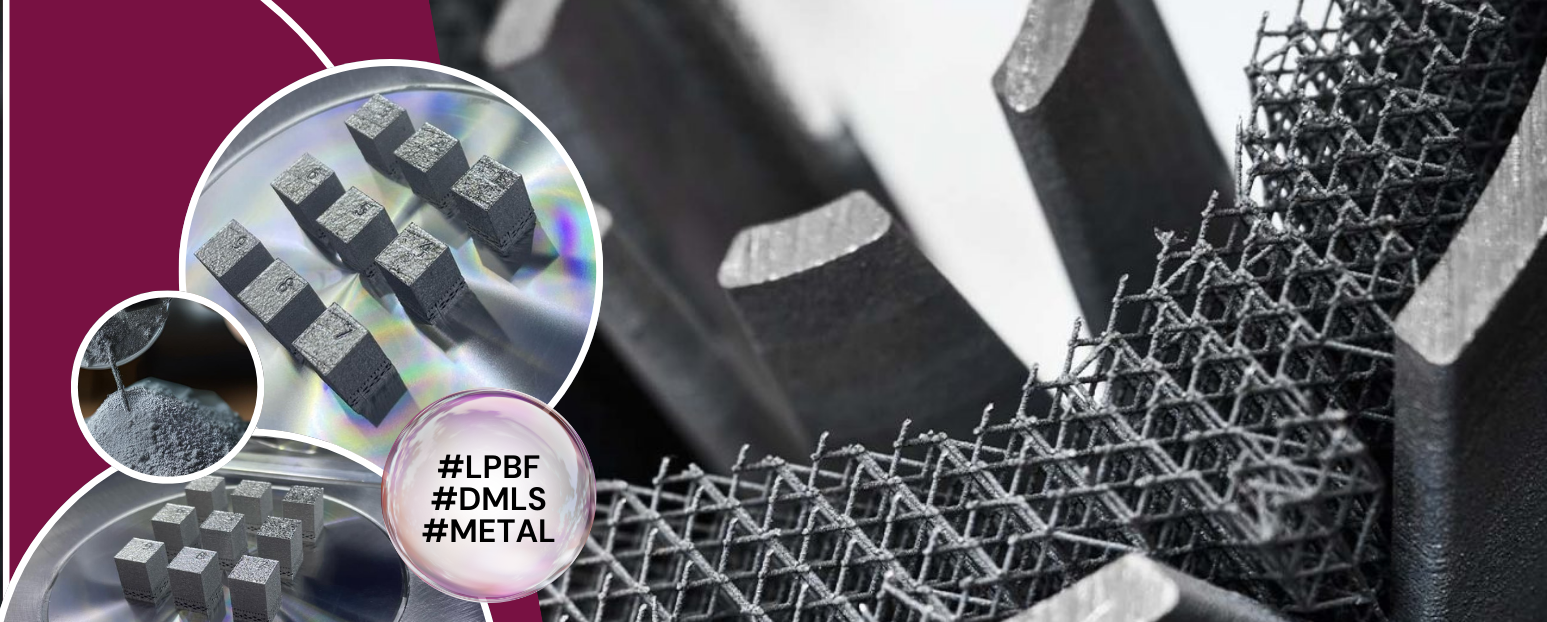
DMLS—Direct Metal Laser Sintering—is one of the most widely used ways to 3D print real, functional metal parts. It’s precise, works with strong materials, and allows you to create complex shapes without molds or tooling.
That’s why engineers, researchers, and startups rely on it for everything from prototypes to production parts.
However, traditional DMLS machines are often expensive and complex to manage. AO Metal changes that. Our compact, affordable 3D printers, starting at $59,000, bring reliable DMLS printing to more labs, classrooms, and workshops.
This guide will explain how DMLS works, what materials it uses, and how it can support your work. You’ll also learn how AO Metal makes starting and staying productive easier.
Looking for a metal 3D printer that fits your work?
Explore AO Metal Printers
What Is DMLS? A Clear Look At Direct Metal Laser Sintering
DMLS stands for Direct Metal Laser Sintering. It’s a type of metal 3D printing that uses a high-powered laser to fuse metal powder into solid parts, layer by layer. The process is digital, based on a CAD file, and doesn’t require molds, cutting tools, or casting.
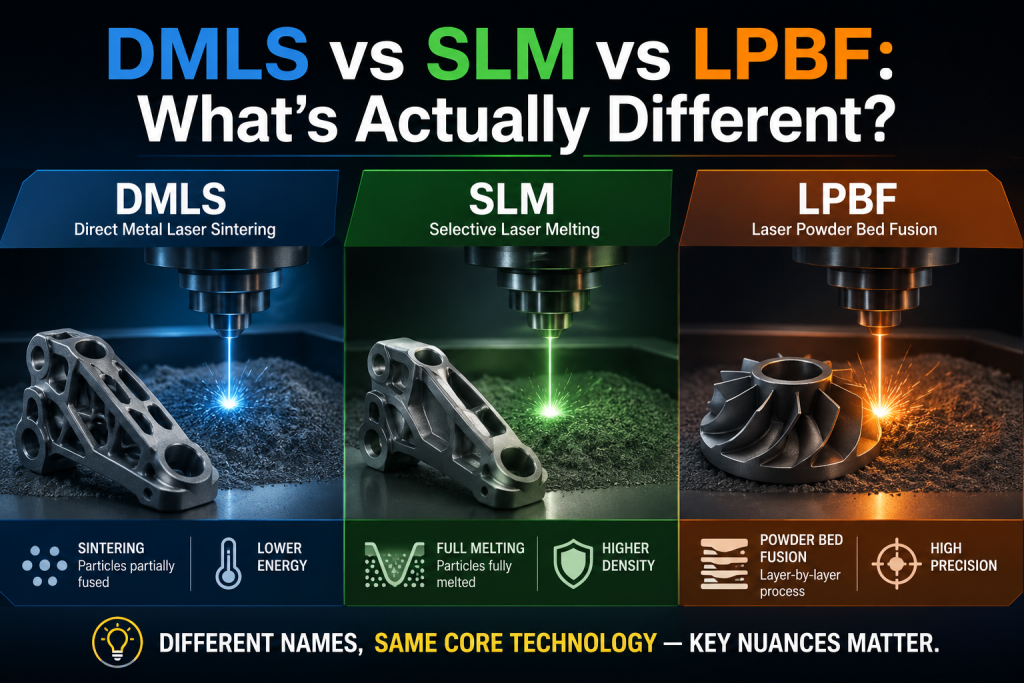
DMLS belongs to a group of technologies called laser powder bed fusion (LPBF). You might also hear terms like SLM (Selective Laser Melting) or DMLM (Direct Metal Laser Melting). They all work similarly, but different manufacturers use different names. DMLS is the term often used by companies running EOS machines, and it’s become widely recognized across the industry.
This method is popular because it produces strong, accurate metal parts with fine detail and good surface finish. It’s used in aerospace, medicine, energy, and research, especially where traditional manufacturing is too slow or limiting.
If your work involves testing new designs, materials, or processes, DMLS gives you a practical way to build and iterate without waiting on external suppliers or large production runs.
What Is DMLS? A Clear Look At Direct Metal Laser Sintering
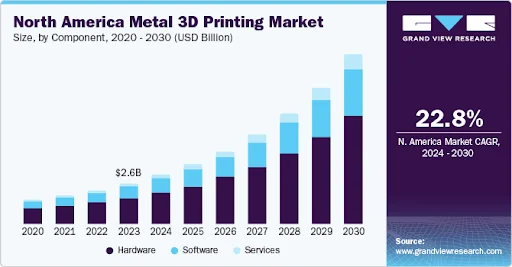
Source: Grand Review Research
DMLS stands for Direct Metal Laser Sintering. It’s a form of metal 3D printing that uses a high-powered laser to fuse metal powder into solid parts, layer by layer. The process starts with a CAD file and doesn’t require molds, tooling, or casting.
DMLS falls under a broader laser powder bed fusion (LPBF) category. While the core process is similar, you might come across other names:
- SLM (Selective Laser Melting) – used by SLM Solutions
- DMLM (Direct Metal Laser Melting) – used by GE Additive
- DMP (Direct Metal Printing) – used by 3D Systems
This method is popular because it produces strong, accurate metal parts with fine detail and good surface finish. It’s used in aerospace, medicine, energy, and research, especially where traditional manufacturing is too slow or limiting.
If your work involves testing new designs, materials, or processes, DMLS gives you a practical way to build and iterate without waiting on external suppliers or large production runs.
How DMLS Works – Step By Step
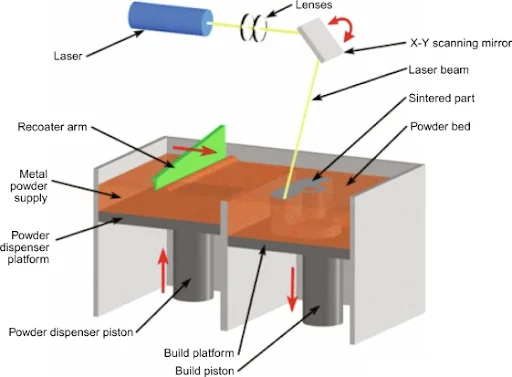
Source: Science Direct
DMLS builds metal parts directly from digital designs by fusing layers of powder using a laser.
Here’s a clear look at how the process works from start to finish:
1. Design Your Part
It all begins with a 3D model. You create the design using CAD software or import it from a file. Then, slicing software breaks the model into thin cross-sections and prepares instructions for the printer. This includes part orientation, support structures, and laser pathing.
2. Prepare the Build Chamber
The printer is filled with fine metal powder—titanium, stainless steel, Inconel, or another metal alloy. The build area is sealed, and inert gas (like argon or nitrogen) is pumped in to create a stable atmosphere that prevents oxidation during the laser process.
3. Layering and Sintering Begin
A thin layer of metal powder is spread across the build platform using a recoater blade or roller. The DMLS laser then traces the first layer of the part, fusing the powder into a solid structure. Only the areas defined by the sliced model are sintered; the remaining powder remains loose.
4. Repeat the Process
Once a layer is complete, the platform lowers slightly, often by just 20–60 microns. A new layer of powder is spread, and the laser fuses the next shape. This cycle repeats hundreds or thousands of times, depending on the part’s height, until the whole part is built from the bottom up.
5. Cooling and Powder Removal
After printing, the part cools inside the build chamber. Once safe to handle, it’s removed from the powder bed. The loose, unused powder is collected, filtered, and often reused for future builds.
6. Post-Processing (If Needed)
Some parts may be ready to use right away. Others may need support removal, stress relief heat treatment, machining, or surface finishing—depending on your project’s tolerance and application needs.
This method produces precise, fully dense metal parts that are ready for testing or real-world use, without molds or long lead times.
Also, read:
Why Choose DMLS? Practical Benefits (And Challenges) For Real-World Work
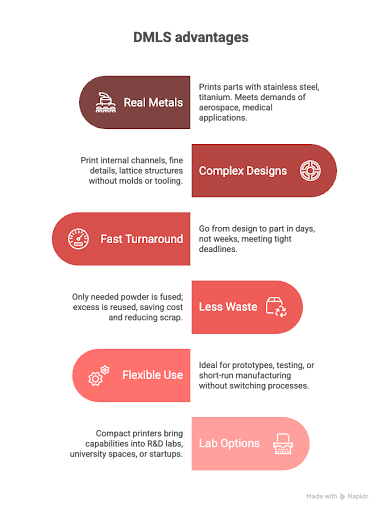
DMLS has become a go-to choice for teams that need real metal parts without the long wait or high costs of traditional manufacturing. The benefits are clear whether you’re prototyping, testing, or producing low-volume runs.
Here’s what makes Direct Metal Laser Sintering a smart choice –>
A quick note on challenges
DMLS requires some learning to operate effectively. It’s not a plug-and-play system—you’ll need to understand powder handling, file preparation, and basic maintenance.
Depending on your surface and tolerance needs, post-processing may also be necessary. But with the right setup and training, these challenges are manageable and often well worth the results.
Materials Used in DMLS 3D Printing
One of DMLS’s strengths is its ability to work with a wide range of real metals. This makes it useful not just for prototyping but also for functional, end-use parts across industries like aerospace, medical, tooling, and jewelry.
DMLS works by sintering powdered metals—fine particles that are melted together using a laser in a controlled environment. The type of powder you choose will directly affect your part’s strength, heat resistance, biocompatibility, and more.
Here are some commonly used DMLS metal materials:
- Stainless Steel (316L, 17-4PH): Strong, corrosion-resistant, and great for general engineering, tooling, and medical components.
- Titanium (Ti6Al4V) is lightweight, strong, and biocompatible. It is widely used in aerospace and orthopedic implants.
- Inconel (IN718, IN625): A high-temperature nickel alloy used for turbine parts, engine components, and aerospace brackets.
- Aluminum Alloys (AlSi10Mg): Low weight with good thermal and mechanical properties. Common in automotive and consumer products.
- Copper and Copper Alloys have excellent thermal and electrical conductivity. They are useful in electronics, heat exchangers, and tooling inserts.
- Cobalt Chrome – Wear-resistant and used in dental and orthopedic applications for its durability and biocompatibility.
Some DMLS printers—like AO Metal’s models—can also handle reflective or hard-to-process metals, such as pure copper or platinum, thanks to advanced blue laser technology. This opens the door to more specialized applications that standard infrared-laser printers struggle with.
Choosing A DMLS Printer That Fits — What To Know Before You Buy
DMLS printers are powerful tools, but many are designed for large-scale operations with big budgets. At AO Metal, we’ve taken a different approach—creating compact, lab-ready machines with the same precision and material flexibility, starting at $59,000.
Whether you’re printing test samples, jewelry molds, or real production parts, our printers are made to fit your work, not overwhelm it.
Built for education, research, and material development.
- Ø30 × 60 mm build volume
- 200W infrared laser
- Fast powder change (<1 hour)
- Compact size (fits on a table)
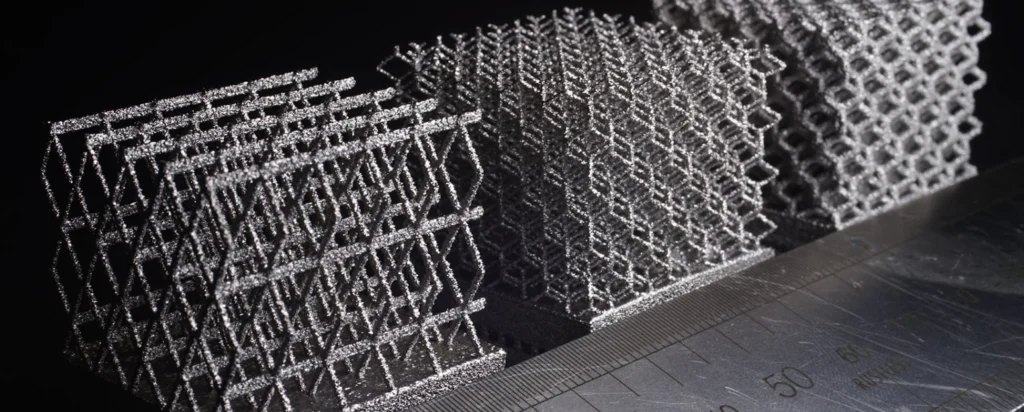
Ideal for labs, students, and testing gyroids or short tensile specimens
A mid-range option with more flexibility and precision.
- Ø50 × 50 mm build volume
- Higher resolution, improved stability
- Designed for both experimental parts and limited-run components
Good balance for startups and universities working on real parts
Designed for advanced research and small-batch production.
- Ø100 × 100 mm build volume
- Blue + infrared multi-laser system
- Handles high-reflective and hard-melting materials (like pure copper and platinum)
- Best for R&D teams developing new alloys or optimizing production processes
All AO Metal printers are built for quick setup, open material access, and real lab or workshop conditions—no cleanroom or industrial infrastructure needed.
What to Look For in a DMLS Printer?
Before you decide on a system, consider these factors:
- Build Volume – Choose the right size for your typical part. A30 is great for small test prints, while the A100 fits short-run production or larger prototypes.
- Laser Power and Compatibility – Reflective metals like copper require more than standard infrared lasers. The A100’s blue laser system is specifically designed for that.
- Material Access – All our printers support open powder use and fast material swaps, so you’re not locked into a vendor’s ecosystem.
- Footprint and Power Requirements
AO Metal systems run on standard power and are sized for real labs—not factory floors. - Ease of Operation – No steep learning curve. These printers are made for hands-on use, with guided setup, clean changeovers, and minimal maintenance.
- Support and Cost of Ownership – We offer fast support, free onboarding, and honest service. No hidden fees or complex service contracts.
If you’re running a lab, startup, or university program and want a reliable DMLS printer that fits your space and goals, we’d love to help.
Request a quote or talk to our team
Use Cases & Applications By Industry
DMLS is used across a wide range of industries where traditional manufacturing methods fall short. From research and product development to custom medical devices and jewelry, it gives teams the ability to work with real metals, produce complex parts, and move faster without relying on external suppliers.
Here’s how different fields are putting DMLS to practical use:
Research & R&D Labs
Academic and corporate labs use DMLS to test new alloys, create detailed test geometries, and experiment with functional designs. With access to open parameters and fast material changeovers, researchers can run repeatable tests without outsourcing or waiting weeks for parts. Compact machines like the A30 and A100 fit well in lab spaces with limited room and controlled budgets.
Aerospace & Defense
DMLS allows engineers to print lightweight, high-strength parts such as brackets, engine components, and internal cooling channels. By replacing multi-part assemblies with a single printed structure, teams reduce weight, complexity, and potential points of failure, especially when working with high-performance materials like Inconel or titanium.
Medical & Dental
DMLS is commonly used to create custom implants, surgical tools, and dental prosthetics. Titanium’s strength and biocompatibility make it ideal for patient-specific parts. Dentists and labs benefit from the speed and detail DMLS offers, mainly when producing crowns, bridges, or partial dentures in durable metal alloys.
Startups & Engineering Teams
For teams developing physical products, DMLS helps reduce time to first prototype and eliminates the need for tooling. It’s also a practical choice for short production runs, product validation, or custom functional parts. With AO Metal’s accessible pricing and compact systems, startups can bring metal printing in-house without massive upfront costs.
Jewelry & Fine Detail Manufacturing
Jewelry designers use DMLS to produce high-resolution molds and direct metal prints in precious alloys. It allows for faster production of custom pieces and complex forms that would be difficult to cast manually, reducing time and improving design flexibility for short-run or one-off items.
No matter the industry, AO Metal makes it easier to bring metal 3D printing closer to where the work happens—whether that’s a lab bench, design studio, or classroom.
Have a specific use case in mind?
Reach out to see which AO Metal printer fits your workflow.
DMLS Is A Practical Tool For Modern Metal Production
Direct Metal Laser Sintering allows you to design and produce strong, accurate metal parts without relying on traditional manufacturing tools, molds, or long lead times. Whether you’re developing materials, building prototypes, or creating functional components, DMLS puts control back in your hands.
At AO Metal, our goal is to make that process more accessible. With compact printers, open material systems, and pricing that starts at $59,000, we help more labs, startups, and educators take advantage of metal 3D printing without the barriers that have held teams back in the past.
If you’re looking for a DMLS printer that fits your space, your team, and your workflow, we’re here to help.
Explore our DMLS printers or request a quote today.
See AO Metal Printers
Most asked questions
Frequently asked questions
Can DMLS sintering be used for electronics or heat-sensitive components?
Yes, DMLS sintering can produce metal parts for thermal management and RF shielding in electronics. While it’s not used to print active electronic circuits, it’s ideal for housings, heatsinks, and connectors due to its thermal conductivity and material range, especially when using copper or aluminum alloys.
What’s the difference between using DMLS for R&D versus full-scale manufacturing?
In R&D, direct metal laser sintering (DMLS) is often used for parameter testing, material development, and geometry validation. For manufacturing, the same technology can produce final-use parts if the printer and process are properly validated. AO Metal systems are designed to bridge this gap by supporting both experimentation and low-volume production.
Do I need special facilities to run a DMLS sintering system?
No. Many compact DMLS sintering systems, like those from AO Metal, are built for standard lab environments. They require basic ventilation, stable power, and safe powder handling procedures—but not cleanrooms or industrial-scale infrastructure.
Is DMLS cost-effective for custom one-off parts?
Yes. Direct metal laser sintering (DMLS) is often chosen for low-volume or custom parts because it eliminates tooling and long lead times. While powder costs and post-processing should be considered, it remains a practical option for producing single parts with complex requirements.
How does direct metal laser sintering DMLS compare with CNC machining for precision?
While CNC machining is more precise in some high-tolerance applications, direct metal laser sintering DMLS allows you to print parts with internal features, lattice structures, or undercuts that machining can’t produce. DMLS can achieve excellent precision, especially with post-processing, and is often better suited for complex or weight-optimized designs.
What should I know about powder reuse in DMLS sintering?
Reusing powder in DMLS sintering is possible and common. However, the powder must be filtered and tested to maintain consistent particle size and composition. AO Metal printers are built to support safe, efficient powder recycling workflows for regular users.
More from the blog
Thinking about a metal printer?
See the A30, A50 and A100, or tell us the alloy and the part.